This month I had the privilege of attending the BCPVPA Short Course I, held at UBC from July 3 – 7. This week-long intensive course is designed to provide new and early-career school leaders with the opportunity to refine their leadership skills and connect and network with other like-minded professionals at similar stages in their profession. I’m sometimes asked by budding school leaders, or those who are in the role, but never took the opportunity what Short Course I is all about. So here it is.
For the 41st edition of Short Course I, we had assembled the largest group educational leaders ever to attend this program. This year’s theme was “Leading Learning: Thriving in a Time of Innovation and Change”. Each day, the course focused on a different domain from the Leadership Standards for Principals & Vice-Principals in British Columbia. In the following I break down just some of the highlights of what was covered each day.
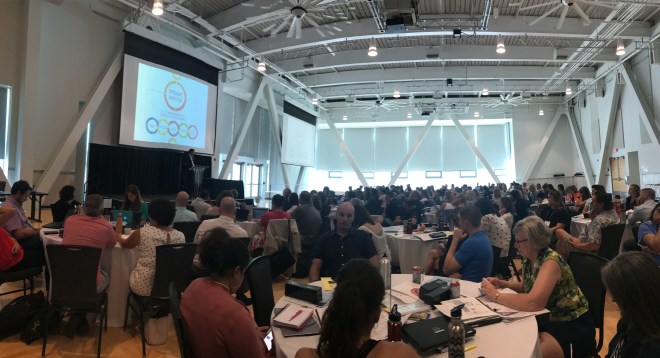
Day 1 revolved around Moral Stewardship.
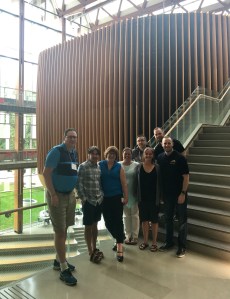
830AM We met in our pre-determined ‘family’ groups, each chaired by a veteran facilitator who had been to Short Course before. I was at table 16 and my facilitator, Anne Smith, was a Principal from Ecole Lac des Bois in Prince George. Anne had already played this role a number of time previously and I could tell from her enthusiasm and confidence that she was going to be a wonderful facilitator! Our team had to come up with a team name, and I whimsically suggested “Sweet 16” because Anne had brought a bunch of candy for our table, and it stuck. Team Sweet 16 was formed!
915AM After some table talk, we were given a formal welcome to UBC by Blye Frank, the Dean of Education. Mr. Frank reminded us that when doing traditional acknowledgements at our schools, that we are not in a position to welcome our staff and students to traditional territories, that was are only permitted to acknowledge where we work, play and live. An important distinction, to be sure.
Our Co-Directors for the conference, Liz Bell and Jessica Antosz, as well as Kim Maxwell, the BCPVPA Professional Learning Senior Assistant, were introduced. I was fortunate to already know Liz from her great work previously in the North Vancouver School District. They set us up with what the structure would be for the week, and discussed some of what we’d need to know – everything from the philosophy and vision of the short course to tech access and where our break out rooms would be located.
945AM The Superintendent of Schools in Vancouver, Suzanne Hoffman, spoke to us about Passion For Leadership. A few highlights I took from this talk revolved around modeling leadership – ‘show, don’t tell’, and to lead humbly which is something I try to emulate in servant leadership. One of her most quotable questions was about, “what is your flagship?”, meaning what is the one thing you’re known for around your school community. She gave the group a moment to reflect when asking if we could name off all of our students who are in care, or who are indigenous. And finally she reminded me of a book I’ve meaning to read – Carol Dwecks, “Mindset: The New Psychology of Success”, where she discusses having a ‘growth mindset’.
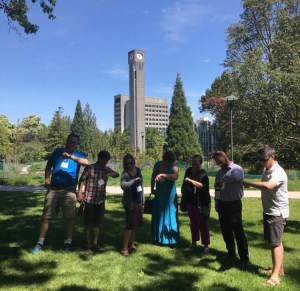
11:20AM Our family groups engaged in a team building exercise called a ‘Goose Chase’. This was essentially a scavenger hunt around UBC where we had to take photos of our group doing funny poses in different areas after figuring out clues. Teams were finishing the challenges so quickly, that more had to be added while we were playing. Our team ended up finishing 3rd out of 25 teams! It was fun to see the other team’s photos posted on the activity feed in the app throughout. I’m contemplating doing it with our staff around Handsworth during the first week back in September.
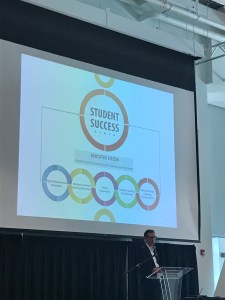
12:00PM Lunch each day was provided by UBC catering and was outstanding!
12:45PM BC’s Assistant Deputy Minister of Education, Scott Macdonald, spoke with us about data driven decision making in BC’s education system. He highlighted that high performing schools have high performing administrators, but also recognized that energies are not limitless and when we’re considering where to apply them to think about some measurables like graduation rates. He also had some interesting statistical comments about students who are December babies, versus students who are January babies and what some strategies might be to mitigate the differences between birth months in the same grade.
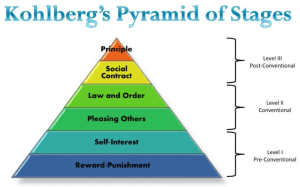
1:30PM Liz Bell and Kevin Fadum facilitated a session on ‘Decision Making’, giving us a process by which we could reflect on how we make our decisions, and what values those decisions are grounded in. Kohlberg’s pyramid of stages was referenced in discussion what motivates people, particularly when interests are competing. We discussed values, morals and ethics and look at analyzing ‘Right VS Right’ dilemmas where clear-cut answers were not always obvious.
3:45PM Our afternoons were spent each day unpacking with our family groups reflections from the day. Around 4:30 we broke for the day, save for the large number of folks who stuck around for the evening Ignite session in the UBC Nest patio.
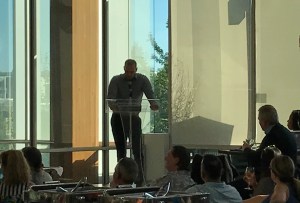
5:00PM In the evening, New Westminster Principal John Tyler organized an Ignite session. Ignite talks are similar to Ted Talks in that they are structured talks delivered by presenters with accompanying visuals. An Ignite, specifically, is exactly 5 minutes long consisting of 20 slides timed to run at 15 second each. I was one of 5 presenters to speak during the Ignite session, talking about my first year as a Vice Principal. Much of the content of what I spoke about was taken from my blog entry, ‘My First 100 Days’. A big thanks to my colleagues from North Van, Jeeniece, Jillian and Brigette, who were also at Short Course and stayed to support me.
Day 2’s theme was Instructional Leadership
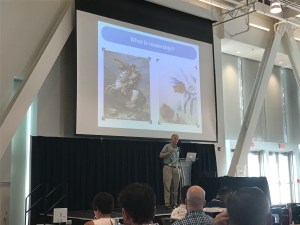
9:00 Our first speaker of the day was the former Superintendent of Richmond Schools, Bruce Beairsto. His topic, broadly, was instructional leadership, but specifically how do we lead learning. His use of the male / female archetype when discussing leadership styles and the accompanying images of Napoleon and Mother Theresa gave the group pause for thought and fodder for discussion later in the day. Mr. Beairsto compared influence versus authority, commitment versus compliance and inspiration versus instruction when discussing influential leadership against management authority. He also defined professional autonomy for us, emphasizing what ‘professional’ really means – a voluntary adherence to a high ethical standard of expectations.
11:00 – 12:30 / 1:30 – 3:00 The majority of our day today was dominated by two different breakout sessions. Each session focused on a different aspect of Instructional Leadership. The intent was to have a different member from each family grouping attending a different session so that all would be covered and the learnings could be reported back to the group for mutual benefit. The only drawback to this was that I found myself in the same sessions as some of my North Vancouver colleagues, and we had intended on similarly distributing our time across the sessions for mutual benefit, but it didn’t end up working that way due to our family group obligations. We also didn’t get the chance to support our North Van colleague, Rob Smyth, at his session on Understanding the Why: Leading and Learning in Aboriginal Education.
The first session I attended in the morning was called Working in a Unionized Work Place and was led by Kevin Fadum, and Debbie Craig. After all the attendees introduced themselves and their work context, Kevin and Debbie walked us through understanding collective agreements – both provincial and local language. We talked about management rights and responsibilities. Unfortunately we ran out of time before getting through all the content that was prepared for us, but what we did cover was extremely informative.
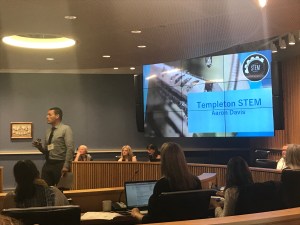
The second session I attended in the afternoon was in the Kingsmill Forum, a fancy round seminar room that looked sort of like a city hall chamber. Here I listened to a panel of speakers talk about Leading the Redesigned Curriculum. After an overview discussion about how to effectively lead change, we delved deep into 4 different examples – 2 from elementary and 2 from secondary – of school leaders examples of employing new curriculum. The secondary examples, which were most relevant to me were 1) Aaron Davis, VSB Director of Instruction, speaking about Templeton’s STEM Program, and 2) Pedro Da Silva, also a VSB Director of Instruction, sharing the certificate program used at John Oliver Secondary. During this session I also had a great chat with one of my family group members, Mike Moloney, VP at Panorama Ridge Secondary, about using of course outlines as one way to gauge successful implementation of new curriculum. If teachers are successfully using the new curriculum, it should be evident in what they’re assessing, which would ideally also be described in their outlines.
Day 3 was all about Relational Leadership.
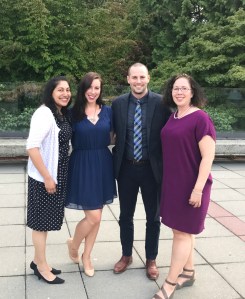
We began the day with a unique welcome from a Tibetan horn. One of the major pieces of today was all about First People’s perspectives – ways of knowing and learning. We were welcomed by Elder Roberta Price of the Coast Salish People, who shared some personal stories with us.
9:00 – 10:30 Our first session on Aboriginal Education was titled Understanding the Why: Leading and Learning in Aboriginal Education and was led by Brandon Curr, District Principal for Indigenous Education in Burnaby, and our own Rob Smyth, Norgate Elementary Principal, from North Vancouver. The speakers encouraged us, especially, to make sure we were connecting with our local aboriginal groups to ensure their voices were being heard. To describe our fluency, appreciation and use of First People’s principles in education, a metaphor of piloting a canoe was used. Some of us are just at the stage where we are carrying the canoe to water, while others are fully immersed, piloting in deep waters. Three questions that help guide our discussion included: 1. What are your experiences with aboriginal worldviews and experiences? 2. What reservations or doubts do you have about journeying into deeper waters with aboriginal worldviews and perspectives? 3. What commitment can you make to journey into deeper water with aboriginal worldviews and perspectives? During this session, there was also mention made of a North Van canoe and kayak tour operator named Takaya Tours. I know other schools in our district, as well as our school board, have taken staff on such an experience, and it occurred to me that this might be a great idea for our staff some time in the next year.
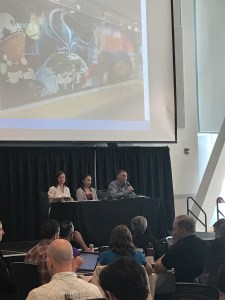
11:00 – 12:30 After break, Terry Beaudry, Deputy Superintendent of Schools in the Central Okanagan, facilitated a panel discussion on Our Calls to Action – Truth and Reconciliation. I really liked Rob Smyth’s open question, asking us to look beyond our professional work and to contemplate what is our personal call to action when it comes to reconciliation. As I’ve been working on our school plan the last couple of years, I was reflecting during this discussion about ways I could more meaningfully incorporate aboriginal perspectives into the plan. We’re also in the midst of planning a rebuild of Handsworth, and I like the idea that signage, such as bathrooms, could be posted in local aboriginal language. Our school theme for next year is going to be “Building Connections” and everything I heard during the panel discussion certainly spoke to that theme. The best quote to summarize the discussion would probably be, “Watch, listen, & show respect.”
1:15 – 2:45 In the afternoon, Maeve Buckley, a retired principal and leadership coach from the Central Okanagan, ran a session on leadership with us. She kicked off her session with an energic round of group sing to the song RESPECT, and carried this theme through her presentation as she used the same word, respect, as an acronym for leadership elements. We looked at different types of leadership styles, and watched an interesting clip on ‘Presence & The Drama Triangle’.
Maeve commented on the importance of self-awareness and self-reflection as a factor that predicates success as a leader, and it gave me a heightened appreciation for the reflective blogging I do! She also reminded us to speak positively, and that the absence of negative talk is only neutral, not positive. The main activity we participated in was a 4 corners activity where we were asked to consider which type of boat represented how was navigated change – a speed boat, sail boat, kayak or cruise ship. As we went around the room justifying our choices, there were some very interesting rationale; everything from how easy or difficult altering course was, to how many people could be brought along successfully with the change, or to what motivate or powered the boat’s change in direction. The boat was certainly an apt metaphor!
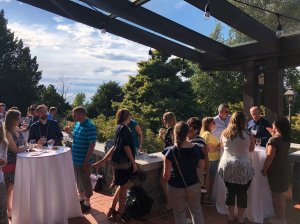
We wrapped the formal portion of the day a debrief with our family groups and facilitator before heading home or to our hotel to prep for the evening social. Today’s social was a wine and cheese event sponsored by the BCPVPA legal team and hosted by UBC / BCPVPA staff at Cecil Green House.
Day 4’s theme was Organizational Leadership and we began the day organized a little differently – this time in our ‘affinity groups’. These groups better represented the context we worked in – elementary or secondary, size of school, French immersion, alternate school, etc. The idea was to work today with folks who we were more likely to share a similar context with so we could, perhaps, relate better on the issues discussed throughout the day. During this morning, I got to meet another fellow VP from Sea to Sky, Jenelle Kresak.
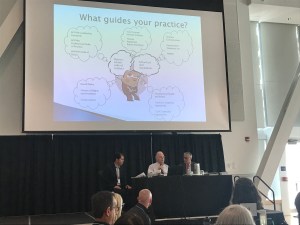
Today was a lot of ‘legal stuff’ and understand roles, responsibilities, and what guides our practice as administrators. Our BCPVPA Legal and Contract services team was on hand to deliver a presentation, and supporting them was Allen Soltan of DLA Piper, LLP. Some of the topics covered included:
- How the Law views the role of the Principal & Vice Principal
- Guiding frameworks for practice (School Act, District Policy, TRB Standards, etc, etc)
- Duties / Responsibilities of Principals & Vice Principals
- Case Studies around social media use, duty to supervise
- Use of force / restraint
- Privacy / Access to Information
- Workplace Bullying / Harassment & Discrimination
- Elements of a personal services contract & benefits
- Negotiation Agency of the BCPVPA
It was great to have bona fide legal advice on hand for the session to answer questions from our group. If I had a tip for next year’s group I’d say have all your burning legal questions ready to fire for this day.
Because we were organized in our Affinity Groups this day, we also had some great table talk with people in similar contexts. We also got a first peek at a phenomenal new resources for Principals and Vice Principals called the BCPVPA Start Smart Planning Guide.

While there’s no ‘how to’ manual for how to be an administrator, this new resource covers a lot of topics for new admin who may not even know what questions to ask or where to start. It’s being polished up and will be shared more widely soon, so keep your eyes out for it.
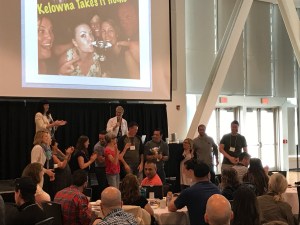
Friday, Day 4 was also the day of our evening banquet held at Sage Bistro. We had a few speeches from guests, spent time and took photos with our family groups and even had a dance competition. And despite a strong showing from Prince George, and an unnamed city who pre-emptively put their names on the trophy, it was Kelowna who ended up winning the dance competition by being the town with the last members standing on the dance floor at the end of the night. It was also nice during this evening to reconnect with my colleagues from North Van to check in and see how their experience at short course had been going so far.
To finish out the week, Saturday’s theme was “Inspiration to Lead”. We started a bit earlier as breakfast was provided this morning. Our family groups gathered once more to start to the day, and we began once more with reflections on yesterday’s learnings.
9:00 – 10:00 Our first speaker for Saturday was Pat Duncan, Superintendent of Learning with the Ministry of Education. Pat had given brief words of welcome at the previous night’s dinner, but today we really got to hear some detailed information from him on behalf of the ministry. He introduced himself first and foremost proudly as a teacher, and in doing so reminded us never to forget that’s what we are. His main purpose was to talk about the new BC curriculum and the WHY behind it all. He took us through the origins of its creation and some of the guiding questions that drove the process, including “What is worth learning?” He encouraged us to imagine teachers as coaches, mentors and activators, not the keepers of knowledge. And that being good at work sheets and memorization are not top skills for students entering the workforce. To demonstrate the difference between knowledge and understanding, Pat showed us a great clip about the Backwards Bicycle.
11:00 – 11:20 David DeRosa, the new President of the BCPVPA gave a brief talk on leadership, focusing on health, wellness and balance, giving a background of the BCPVPA and encouraging members to be involved in committees like chapter council and the issues forum. Something to consider in the future for sure!
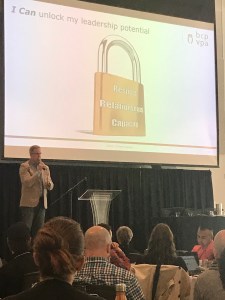
11:20 – 11:40 Our final formal presentation of the week came from Kevin Reimer, our outgoing President of the BCPVPA as well as the incoming Executive Director. Kevin’s talk was titled ‘Learning, Leading and Laughing’, with the tongue-in-cheek subtitle ‘Learning from Kevin’s Many Leadership Mistakes’. He told us a wonderful story about a school he worked with in Comox who made their theme for the year “We Can”, and picked a theme song by a relatively unknown artist named Jesse Ruben. Jesse ended up coming to visit the school to shoot a music video with the school, and his work supporting students through the ‘We Can’ project spread from there! Kevin also talked about the importance of credibility, and the need to re-establish it at every new school you work at, and contrasted the difference between deep influential power versus authoritative, ‘cheap’ power. His final piece of inspiration was a quote he keeps on a post-it note on his computer monitor, to “Increase the Life Chances of Every Child” – and this should be our focus every day!
Short Course I was an inspiring, engaging (and exhausting!) full week experience of professional development. In the end, I would highly recommend it for any administrators who are early in their career. I think it was definitely valuable to have experiences to draw on, particularly during discussion times, so with that in mind I’d suggest that if you’ve never actually worked as a VP or P, it would be a conference better attended after you’ve spend a year in the role. The conference runs much longer than a typical day, so be prepared to spend your evenings out as well. I know many of the participants, particularly those from out of town, ended up staying at UBC in some of the rental housing, which is a great idea. Beyond the learnings and tools for the toolbelt, I just really enjoyed networking with a large group of people who were at a similar stage in their roles as administrators. You can never have a large enough support network for a role like this, and having people in other districts with a detached, informed and unique perspective on issues you may handle in the role is such an asset. A big thank you to organizers Liz, Jessica and Kim, and to our fabulous Group 16 facilitator, Anne! If you’ve attended a Short Course and have some perspective to add, please feel free to add your comments in the space below.
 Education Rumination