With the recent introduction of BC’s Numeracy Assessment, and the upcoming release of the Literacy Assessments, there’s been renewed attention given to the Proficiency Scale used to assess student performance. Occasionally I get some confused questions about the differences and similarities between Performance Scale and Proficiency Scale, so I thought it worth providing some clarity.
What is Performance Scale?
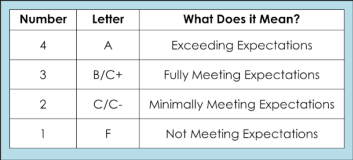
Performance Scale, or Performance Standards, focuses on assessment of student performance where students are asked to apply the concepts and skills they have acquired to complete complex tasks. This type of assessment supports criterion-referenced evaluation by enabling the comparison of student performance to established standards. The BC Performance Standards have established the following four levels of student performance. They are:
- Not Yet Within Expectations
- Minimally Meets Expectations / Approaching Expectations
- Fully Meets Expectations / Meeting Expectations
- Exceeds Expectations
At Handsworth, you’ve likely seen Performance Standards on your son or daughter’s report card in Grade 8 or 9 perhaps in their Careers course, their ADST rotation, band class, or even Science. The graphic below shows an approximate comparison between each of the standards, but I think this can be misleading. As I’ll discuss below, the purpose of using Performance Standards is really to get away from letter grades, so tables like this that draw a direct line from one to the other are really counterproductive.
In North Vancouver, we’ve also been experimenting with our Student Information System, MyED’s, capability to run a ‘Standards Based Gradebook” where we can identify the curricular competencies we hope students are developing and evaluate their relative mastery in each of them using the Performance Standards.
What is Proficiency Scale?
While it is not new, a sound understanding of Proficiency Scale grading moving forward is vitally important in BC, as the latest Student Reporting Policies from the Ministry of Education outline that this will be integral for reporting student progress. Similar to Performance Standards, Proficiency Scale divides student demonstration of understanding into 4 categories. They are defined as:
- Emerging
- Developing
- Proficient
- Extending
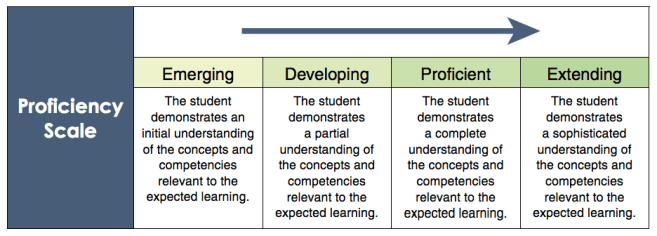
Elementary Students who complete the Foundation Skills Assessment’s in grades 4 and 7 have their work assessed using Proficiency Scale. Secondary students across the province will see their Numeracy Assessments, and soon their Literacy Assessments, also graded using Proficiency Scale.
Why don’t we just use percentages or letter grades for all assessment?
While percentages and letter grades continue to be used for classes at the senior grades, there is now an established shift in K-9 assessment practices as standards based grading better support the aims of B.C.’s new curriculum. This emphasis on criterion based assessment is really part of a broader moved shifting the emphasis of education in BC to a culture of learning over a culture of grading. Encouraging student’s curiosity for its intrinsic value, rather than simply to ‘get an A’ is the ultimate hope. Moreover, the introduction of BC’s new curriculum makes this realignment of assessment practices a necessity, and is well-grounded in research. For those interested in reading more about how educational assessment has evolved, I encourage you to read up on Bloom’s Taxonomy VS Webb’s Depth of Knowledge (DoK) to see how new assessment practices are aligned with the DoK model.
 Education Rumination