How I Became a Google Educator

In March of 2015 I undertook the task of becoming a Google Educator. It was spring break and I was looking for a bit of professional development. I’m still not 100% sure how I feel about these corporate certifications, but had at that time been exploring applying to be an Apple Distinguished Educator (ADE) or Google Educator for some time simply because it fascinated me. I use both Apple products and Google software in my classes, so figured why not. Unfortunately the application window for the ADE had closed, so I turned my attention to being a Google Educator. This certification was something I could add to my resume to demonstrate my ability to use “Google Apps for Education”, particularly within schools and districts that utilize them – so called “Google schools”.

What is a Google Educator?

Well, apparently a more appropriate question for me now is, ‘what was a Google Educator’? While I only certified myself 10 short months ago, and my certification is still good for another 8 months, apparently it no longer exists in its former sense. Now Google has changed their certifications by adding different levels, and dramatically altering their exam process. Nevertheless, the purpose of the Google Educator certification is a designation for those who want to qualify for the Google Teacher Academy program or for those who want to become a Google Certified Trainer. In order to be certified (at that time) I had to pass 5 online exams which cost $15 each. Four of the exams were mandatory (Google Calendar, Sites, Drive and Gmail) and then you got to choose from a selection of electives. I chose Chrome. Today there is a Certified Educator level 1 and level 2 before being eligible to become a ‘trainer’ or finally an ‘innovator’. While I know this blog post won’t be incredible helpful to people pursuing the credential via the new process, I still believe that going through these exercises was beneficial to me, and can still be for others.

The Exam Process

I began to prepare for the exams by studying all the training material Google provided. Google still has great training materials for teachers you can find here.  I also went online and read other people’s blog postings about their experiences, such as this one. Many of them gave advice on the time it would take to prepare for each exam. I remember one blogger (who was particularly helpful) suggesting it would take almost two weeks to adequately prepare for each exam, and that it had taken them a full summer to study and pass all the exams. I knew I didn’t want to spend that much time and was looking for ways to fast track my certification. I cram studied in a way I hadn’t done since university and decided to take the plunge with my first exam after only one night of study. A great preparation resource was StudyStack which gave example questions that were similar, but not exactly the same as the one’s on the exams. I started with the Gmail exam as I was most familiar with it and had read that it was one of the easier exams. I knew that if I failed the exam I would have to wait a week before I could try it again, and it would cost me another $15, but I was also anxious to get started and see really how tough the tests were. An 80% score or higher was required on all 5 exams.

My old study habits proved worthy as I passed the first Gmail exam with 88%. Convinced that my method of cramming all night was the right choice, I forged forward not once, not twice, but three more nights in a row, staying up all night to study and then write the exam in the early morning. On the final day I grew particularly brave, even brazen, and went for the ultimate coup de grâce writing 2 exams in a single sitting. 4 days and $75 later I had managed to push through the entire Google for Education Exam schedule.
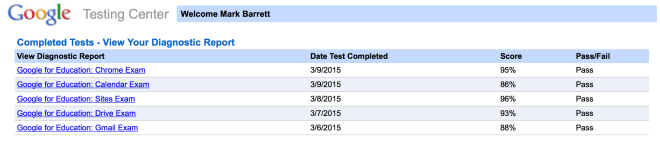
Screen Shot 2016-01-14 at 11.58.44 PM

Was it Worth It?

My purpose in pursuing the certification was originally simply for professional development, and so in that respect it was definitely worth it. I learned some interesting things you could do with the apps, like scheduling open/available appointment times with Google Calendar, and all about the Chrome Web Store, which I had previously not known much about. I actually enjoyed the challenge of cramming for exams, and the nervousness that went with knowing I’d have to wait a week to write again if I failed. Unfortunately with the recent revamping of the program (as of July 2015) I feel like the certification I poured my efforts in to is no longer as valuable. Also, as I alluded to earlier, I’m still conflicted about why someone would need a corporation like Apple or Google to validate their status as an educational innovator. I ‘recertify’ myself every day that I step into the classroom and test something unfamiliar in my instruction or assessment practices. In the end though, the real value of the certification process is the education itself. I have since been able to introduce into my classes a much richer Google Sites experience, and my collegial collaboration with Google Calendar and Drive has also been enhanced. So, all in all, I think it was a valuable experience!


Screen Shot 2016-01-15 at 1.12.51 AM

How I Became a Google Educator

On the Importance of Financial Education

As a business education teacher I have a small bias towards my subject matter, but I think it’s fair to say that students of past and even recent generations have left their K-12 experience sorely lacking in basic financial education.

A typical grade 12 earns their diploma understanding the quadratic formula, meiosis and mitosis, the causes of the French Revolution and how to order from a restaurant in French or Spanish (among other things).  All valuable skills.  But the typical graduate also doesn’t know what an RRSP is, the difference between an asset and a liability, how to file their taxes, how to avoid crippling personal credit card debt, manage students loans or pay a mortgage, and they also don’t know they don’t have to be an employee – that it is actually possible to start your own business.  Personal finance is something we all will have to deal with, regardless of what career path we end up choosing.  And it’s about time we started taking seriously the education of our youth in this respect.

Schools today are great at pumping out employees.  Students learn how to take instruction, meet deadlines, produce work whose parameters are provided to them by a superior, and are all familiar with some type of chain of command.  Conversely, encouraging entrepreneurialism is one of the best ways to push critical thinking skills, problem solving skills and creativity skills.  Want to be an entrepreneur?  You’re gonna need a good idea first.  You’re going to have to solve some problems with respect to production, labor, marketing, etc. And you’re going to need to know how to communicate with and lead a team in order to fulfil your vision.  If we want to encourage creativity, collaboration and critical thinking skills, I can think of no better vehicle than entrepreneurialism.

Personal finance is a second, and arguably even more important skill to master.  People need to understand from an early age the dangers and pitfalls of credit.  One only has to look at the 2008 financial crises to see what effect prolonged accessible and cheap credit can have on people.  Interest rates fluctuate.  My loan rate of today is not necessarily my loan rate of tomorrow.  Credit cards are meant to be paid off each month.  Pay Day Loan companies are financial wolves in sheep’s clothing.  Just because I can buy something doesn’t mean I can afford it.  ‘Frugality’ doesn’t have to be a dirty word.  How are young adults supposed to learn this if it’s not taught in school?  Especially when popular media is persistently encouraging consumption and materialism.

A basic understanding of the stock market, I believe, is also incredibly important.  Whether or not you become an active trader of your personal portfolio or not doesn’t matter.  Almost all of us will in some way be directly or indirectly impacted by the performance of the stock market.  Do you have a company or government pension?  Then you’re in the stock market.  Do you have mutual funds, bonds or even just a mortgage?  All of these can be affected by what happens on the stock market.  If you have no idea of the basic functions of the marketplace, how can you be assured a competent understanding of your own personal economic future?  How can you plan for retirement?  We can put our heads down and work hard and just hope that it will all work out in the end, but I’d far rather see an educated public that understands what fundamental forces are at work behind the scenes.  This, as far as I’m concerned, should begin in high school.

For many families finances are still not a conversation topic at the dinner table.  How often have you discussed with your teenagers what’s left on your mortgage?  Which credit card your family uses most often and why?  How you save for family vacations?  What retirement plans the adults of the family are invested in?  These are all valuable conversations.  Especially if the family finances aren’t perfect – what a powerful learning opportunity!  And maybe it can even provide some impetus to spur the adults on to greater fiscal responsibility.

We ask students what they want to be when they grow up.  ‘A doctor.’ ‘A teacher.’ ‘A lawyer.’  How often have you heard a student say, ’an entrepreneur’?  Statistics vary, but roughly 48% of Canadian’s work for small business.  It’s one of the life-bloods of the Canadian economy.  To start those businesses someone at some point had to take an idea, combine it with a bit of courage and some basic understanding of business development and maybe even the help of a mentor.  We need to encourage students to take a keener interest in business both for their own sake, and for economic benefit of us all.  And even more importantly we need to be graduating students who know how to manage their own finances…  to have them understand the importance of saving for a rainy day…  that the best time to start saving for retirement was yesterday…  how to take care of their financial responsibilities and avoid debt… what it means to pay a mortgage… and to appreciate the fact that the stock market touches us all.  If they gain some collaborative, creative and critical thinking skills along the way I think our economy, our workforce and the financial stability of our families will all be better for it.

On the Importance of Financial Education

In Praise of Team Teaching

Teaching is a social art. The interaction between teachers and students, and students with students is a process we as educators are always trying to find ways to refine. We’ve all heard about the push away from ‘the sage on the stage’ to ‘the guide on the side’, but hopefully it will come as no surprise to people that teaching, does, in fact, at some point require being in front of your students imparting some pearls of wisdom. There’s a reason the traditional lecture is still used in many post-secondary classes. It is still one of the most efficient ways to pack a lot of information into a lesson. But if we’re being honest, listening to one person deliver a monologue on any topic has its limits. If you’ve watched one of the many popular TED talks videos, or been to a TED event yourself you know that the majority of these engaging talks are less than 20 minutes in length. Listening to one voice for any longer can easily become tedious. And here, I would suggest, we find the first reason that team teaching is a technique that should be employed more often.

Two teachers collaborating to tackle a single topic can provide a much more interesting dynamic than any single teacher could. The difference in intonation, inflection and cadence of each speaker can reinvigorate a lesson. Moreover, with each teacher giving their unique perspective on the topic, greater insight and expertise is provided. Some speakers are better at giving concise explanations, while another may teach using anecdotes and stories. In a team teaching setting there’s room for both.

When delivering a lesson solo it can be easy for your plan to be side-tracked, or for you to lose focus on the intended outcomes. Having a second teacher to help guide things back on course can be a huge benefit.   In my experience, class discussions led by two teachers tend to be richer, as having a second ‘expert’ opinion and a second set of rich life experiences can help inform the conversation. Two teachers are able to debate opposing sides of an issue, build upon each others points and can even correct or clarify each others facts thereby ensuring students have an accurate understanding. Clearly a high level of trust and excellent rapport needs to exist between team teachers if they are going to be successful.

A team teaching scenario can provide the potential to pair a novice teacher with a more veteran teacher. Teaching is a profession that benefits immensely from having mentorship relationships. Too often new teachers are thrust unprepared into their first year classroom and are only able to seek out fleeting guidance during lunchtime or afterschool if any colleagues are available.   The mentorship possibilities alone have the potential to raise the quality of teaching for all students.

Another pedagogical advantage is the potential for small group activities. This is made possible by the decrease in the student to teacher ratio. In cases where team-teaching involves even more than two teachers, jigsaw activities and intense small group discussions with increased student engagement and accountability are possibilities. Cross-curricular possibilities abound, with team-teacher pairs emphasizing the connections during a lesson between each of their curricular expertise areas.

Simon and I team teaching in Central Park, New York

My best lessons are the ones I have done in a team-teaching environment. During summer I teach with MEI Academy, a study-abroad program that provides lessons on location around the world. The vast majority of the lessons I deliver during that time are done with a teaching partner. For the last 3 years I’ve been teaching with a remarkable educator and friend named Simon. In preparing together for lessons we’re able to identify which instructional elements each of us should be emphasizing. For example, in a business lesson on game theory I will make sure I’m prepared to discuss Nash Equilibrium and the prisoner’s dilemma, while Simon will make sure he has polished up the accompanying interactive activity which will sharpen the students understanding. In a lesson on debate perhaps I will focus on pathos, while Simon focuses on discussing logos or ethos. Each of us is responsible for making sure a particular element of the lesson is refined, while both being permitted to also contribute to the piece the other is preparing. By focusing on preparing only a portion of the lesson, the prep time required is actually decreased while the quality of instruction is simultaneously enhanced. And with practice and over time the lessons become seamless with each of us contributing our equal part.  In a time when we are, more than ever, asking our students to integrate, synthesize and think critically, having two teachers who are able model the integration of each other’s ideas in front of the class serves as a powerful example.

Simon and I team teaching at the Pantheon in Paris

Simon is a far more entertaining speaker than I am, so I’m thankful when he’s able to interject with an amusing anecdote or story that supports the learning objectives I’m trying to achieve with the students. Having two teachers with different personalities also means we are connecting with the students in two distinctly unique ways. The importance of the teacher-student relationship has been increasingly emphasized as vital for student achievement. This end is clearly supported by having two teachers who are able to cultivate those relationships in different ways.

So why is team-teaching not more widely used? Firstly, it is not economical. For arguments sake let’s say the average classroom holds 30 students. To have two teachers instruct 30 students costs double the price a solo teacher would. “So why not double the space?” you ask. I remember there was a time when this used to be done. At Handsworth we used to have something called ‘large group’, where 60 students would pile into a double sized classroom and 2 teachers would deliver a lesson together. It was great. Students who were all going to be tested on the same content could be sure they weren’t missing something the other students were getting in another teachers class because they were all learning it in the same place at the same time. The novice teachers could see how the senior teachers taught the subject and everyone would be on the same page in terms of the assessment and expectations of the students. But, alas, it happens no more. The complexities of scheduling simultaneous blocks of the same class were such that students ended up taking the class at differing times, and so synchronizing a ‘large group’ appeared to become impossible. And with time it seems that scenario has become a lost discussion. Finally, the large group room that was once used has since been converted into two separate classrooms – a consequence of a school at capacity looking for more instructional space. I suspect the need for smaller separate spaces is similar in other schools that also follow the traditional classroom model.

Many teachers themselves are reluctant to try team-teaching. It falls outside the comfort zone of many who have long held routines and teach their subject the way they’ve always taught it. It takes a teacher who is willing to be vulnerable and not worried about being judged to have a colleague in their classroom while they teach. As professionals, some of us still have this fear that we might be inadequate at what we’re doing, or perhaps ‘behind the times’. And opening the door to another teacher is to expose all our instructional warts. My experience, however, has been that I work with remarkable teachers. And we have far more to learn from each other’s classrooms than we have to worry about. Team-teaching celebrates the great things each teacher has to bring to the table, and doesn’t place a value judgement on what’s not working – because to teach with a partner is to demonstrate a willingness to improve. I hope to have the opportunity to team-teach more in the future as I believe collaborating with colleagues raises the quality of the educational experience for students.

In Praise of Team Teaching

Why I Coach

With yet another basketball season upon us, I thought this might be a good opportunity to take stock of, and reflect upon why it is I coach.

I can still remember playing sports in high school and wondering to myself why on earth anyone would volunteer so much time to a team when their own kids didn’t play on it, and they themselves didn’t even get to play either! I mean, they just stood on the sidelines and did the substitutions and drew up a few plays… it didn’t seem like much fun to me.

Volunteering to coach basketball is a huge commitment. It’s 6 or 7 days a week for 4.5 months of the year. There’s overnight / away tournaments, which means you’re averaging upwards of 20 hours a week in time spent volunteering. ‘Cowichan’ has become a 4-letter word in my house as it means I’ll be away overnight yet again with the basketball team. I’m not popular on those weekends with my family, but it’s a chance to take the team away for some important bonding and quality time. So why do I continue to do it?

The first team I ever coached - Grade 7 Hillcrest Elementary.
The first team I ever coached – Grade 7 Hillcrest Elementary.  My sponsor and principal next to me.

For a bit of context let me take you back to my first real basketball coaching experience. I was in second year at the University of Victoria in 2001, and as part of my teacher preparation program we had to go volunteer to coach a team for a season. There was a local team of grade 7s at Hillcrest Elementary in Victoria that needed a coach for their season and so I dutifully went over to the school and met with the principal. I remember how ecstatic she was that I was there. It was wonderful to be so warmly welcomed by an administrator.  She told me that if I hadn’t come to coach that these boys likely would not have had a team. And what a team they were. Grade 7 is not a lot different than older grades when it comes to a recipe for success. They say you can’t coach height, which turned out to be a good thing for me because my team had 2 boys who were pushing 6 feet tall. I surprised myself with how much I genuinely enjoyed leading the boys through practices, drawing up plays for them to run, modeling good sportsmanship, and making every attempt to have all the boys playing time be as equitable as possible. Having a winning season made my first coaching experience enjoyable, but it was all those little things I had previously thought would be boring when I was a player watching my coaches that I found I really relished.

My Grade 6 Wanouchi Junior High boys team in Japan
My Grade 6 Wanouchi Junior High boys team in Japan. Toshiki is second from the bottom right.

And so I was hooked. For the past 15 years since I’ve been coaching. Even when I lived overseas I made sure I continued to coach. My team of grade 6 boys at Wanouchi Junior High in Japan were easily the least talented group of boys I have ever worked with. We spent an entire season working on the right-hand lay-up (their good hand!). I got to work on my Japanese by repeatedly yelling such phrases as “ASHI CHIGAU!” (wrong foot!) We lost every game that season. But we had so much fun. I can still remember Toshiki, the kid who looked like a sumo-wrestler and was my #5 ‘big man’ and the way he and I would high-five if he even caught some of the rim on one of his shots. I’m not sure he scored a basket that year. It was most evident to me during these times that extra-curricular involvement was where you had the opportunity to cultivate real bonds with students; bonds that tied them to you, and by extension tied them closer to their school community.

Over the years I’ve come to have a new appreciation for the time and effort my coaches put in for me as I went through my K-12 experience. People like Bob Baldwin, Vinny Alvano, Scott Bennett, Peter Therrien and Garth Thomson just to name a few. Without the hours and hours those men put into volunteering with me I wouldn’t be doing what I’m doing today, or be the person I am today. I often think about what their time with me has meant. I know many of the qualities I’ve developed as an adult are due, at least in part, to the guidance they helped provide throughout my own formative years.

Coaching means responsibility. It means leadership. It means having to bite your lip when you’re upset at an official’s call because you know you have a bench of 15 impressionable minds sitting next to you. It means knowing when to encourage and when to discipline. How to provide expectations and help athletes set goals. It’s about dealing with fragile egos, disappointments, and acting with humility when you win.

Coaching is not always easy. Cutting players is the worst – I wish everyone could make the team. I’ve been cut from teams and I’ve been one of the last players on the bench. It’s not fun when your name is not on the list or when you never get off the bench – I know that. Coaches have to make difficult decisions, but I try to focus on the fact that in volunteering I know I’ve been able to provide the opportunity for more students to participate than if I hadn’t volunteered at all.

I coach because I enjoy having the group rely on me for guidance and leadership. I coach to pay it forward and thank those coaches who took the time to guide me. I coach because I know the importance of providing opportunity for students to participate in extra-curricular activities. I coach because I enjoy the technical aspects of the game and being able to continually learn more. I coach, selfishly, because it gives me a better connection with my students, and most of all because I’ve found I genuinely enjoy it.

And with that, I’m excited to start another season!

Why I Coach