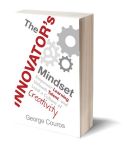
 This past month I read George Couros’ The Innovator’s Mindset. It was a book that came a good juncture in my professional growth as I move from teaching to administration. The book walked a nice line between both a teacher and administrator’s perspective on how to foster a culture of innovation in classrooms and a school as a whole. As with any book on education, I try to see if what I read simply reinforces my existing beliefs, or if it challenges me to see things differently. While much of what Couros writes was already in line with my beliefs, there was a lot of food for thought in the book and moments where I paused to reflect on my own experience and ways I could try to reframe some of the work we’re doing at Handsworth. I thought I might share a few notes and highlights from the book that really resonated with me.
This year our overarching goal at Handsworth has been deeper student engagement, inspired by our work the previous year with Design Thinking. In The Innovator’s Mindset, Couros says that engagement is good, but empowerment is better. I have had a confluence of inspirations between my experiences at High Tech High with exhibitions of student learning, the self-assessment piece coming with BCs New Curriculum and now reading Couros’ comments of moving beyond engagement. I’m excited to see how we can move towards real student empowerment next year. One idea we are working with is to possibly restructure our twice-yearly parent-teacher interviews to have them be, rather, led by students who will share what they’ve been learning, perhaps with a portfolio of work.
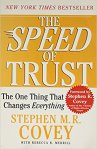 One of the quotes Couros cited early in the book was from American educator and author, Stephen Covey, who talks about the speed of trust. As someone who subscribes completely to the idea that any organization is only as strong as its people and the relationships between them I agree wholeheartedly with the notion that things just get done, and get done faster, where there is an established culture of trust. This culture is developed, as Couros says, “by the expectations, interactions, and, ultimately, the relationships of the entire learning community.” But, even more importantly, relationships are built first on a one-to-one basis. I like Couros’ suggestion that as an administrator it is important to work with smaller staff groups of 2 to 4 people to create an intimacy that is lacking with larger assembly style groups. I have been fortunate to work with some great district administrators in North Vancouver who have also worked hard to create relationships with other staff in those types of smaller working groups. Networking is so important, because, as is mentioned in the book, “alone we are smart, together we are brilliant.” Strong relationships create an environment for innovation.
I had to laugh when the example of Blockbuster was brought up when illustrating the notion that organizations must “innovate or die”. I actually worked for Blockbuster all through my high school and university years. I was an employee there in the year 2000 when a small, little known company named Netflix began its mail order DVD program.

In what is now a fairly well known monumental business blunder, Blockbuster’s CEO had the opportunity to buy Netflix but decided to pass on it because he considered video streaming to be a niche market. Education is also a “business” that is experiencing a rapid transformation. Our students, as “clients”, have higher expectations than ever for how they will be served. It’s on us, collectively, to make sure we aren’t delivering a VHS experience where a digital one is required.
So how do we foster this innovative change we are so earnestly pursuing? Couros says that to inspire change, we must make a connection to the heart first before making a connection to the mind. And again, this really speaks to the importance of relationships – both between staff, and also staff and students. Inspiration comes from embracing possibilities. And as an educational leader, it is going to be incumbent upon me to help create those conditions where creative risk taking and positive change is more likely to occur. A culture of compliance is anathema to fostering innovation. Moreover, it’s important to realize that the improvement of our practice will never really have a finish line. We’re in education after all. If, as a discipline, we’re not constantly adapting and improving, then we aren’t truly living what it means to embrace that culture of learning.
Today, more than ever before, there seems to be this pronounced push and pull between innovative, personalized, big idea learning practices, and the forces of testing, compliance and traditional learning. Thankfully it seems that new thinking is beginning to win the day. School shouldn’t be about “what’s on the test”. It should be a safe and welcoming place where students have permission to make mistakes; to fail quickly and fail often so they learn to find success, not just in the classroom, but also in life. In reading The Innovators Mindset I was reminded of a John Green quote I love.  To paraphrase, it goes, “About the test… The test will measure whether you are an informed, engaged, and productive citizen of the world, and it will last your entire life, and it will be comprised of the millions of decisions that, when taken together, will make your life yours. And everything, everything, will be on it.” Whether or not we prepare our students to be productive, happy and engaged citizen is the real measurement, I believe, of quality of the learning happening in our schools.
There was, however, one assertion Couros made that I wanted to challenge. He asks what is a student more likely to need to know how to write: an essay or a blog post, suggesting that the latter was more important. I understand the irony of questioning this within a blog post, but I have to say that any good piece of persuasive writing, be it an op-ed piece, a blog post or even an online review requires some understanding of ethos, pathos and logos – elements of persuasion that are the foundation of a good essay. This is in addition to understanding the importance of quality evidence and establishing a good structure. This is not to say the essay is the be all and end all, but it gives young writers a great foundation; a platform from which they can propel to all other forms of writing, including blog posts. But maybe that’s just the English teacher in me. Blogging is certainly important. Couros discusses what a fantastic professional development tool it can be, and I have to agree. While I know what I write is read by very few people, it encourages me to refine my thinking on topics in education – something I will increasingly be challenged to do as I navigate the world of administration.
As a budding administrator, Couros reminds me that the higher up any one person is in an organization, the more people they serve. I’m looking forward to serving more people than ever, and hopefully in the process being a force for innovation and change that can affect even more students. One of the most profound questions that came up frequently in The Innovators Mindset was, “Would I want to be a learner in my own classroom?” I will be serving many classrooms now; albeit in a different capacity, so I feel there is an enhanced responsibility to ensure that all classrooms in the school are safe and caring spaces for learning. But beyond that, I think for me, it’s also going to be important for me to ask, “Would I want to be a staff member in my own school?” The Innovator’s Mindset has given me some good inspiration in helping me make that a positive reality.
You can find The Innovator’s Mindset online at Amazon.ca.
 Education Rumination
You must be logged in to post a comment.