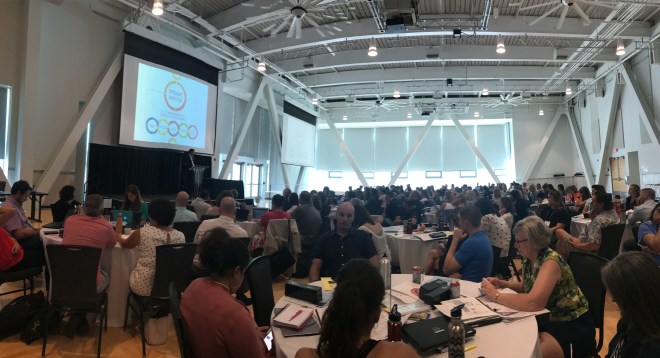
This past Family Day long weekend, my admin partner, Rupi and I headed down to San Francisco for the Learning and the Brain Conference. This 55th edition of the Conference was themed, Educating Anxious Minds, and had a record-setting 2500 participants attend from around North America and beyond. The inspiration for the conference came as a result of recent reports finding that many children and teens are experience significant stress, anxiety, and mental health issues. The purpose was to help education professionals reduce anxiety and stress in schools; address teen depression and challenging classroom behaviours; foster coping skills and mindful practices; create trauma-sensitive schools; and improve school success by prompting positive teacher-student relationships.
As the Professional Development Chair for the North Vancouver Administrators Association, this conference was particularly relevant for me on a couple of fronts. Firstly, I am in the midst of organizing our annual Administrators Conference in Whistler, and our theme for 2020 is the BCPVPA domain of Relational Leadership. Many of the speakers touched on how school-based administrators can positively impact school climate, culture and student anxiety through instructional care models that support staff. High relational leadership capacity is certainly an integral aspect of any successful care model. Secondly, in my same role as NovA Pro-D Chair, I’ve created a network of 5 different book clubs for my colleagues. One of the books being read, The Boy Who Was Raised as a Dog, was authored by the first keynote speaker, Dr. Bruce Perry, and it was enlightening to hear his behavioural science-based approach to understanding anxious students.
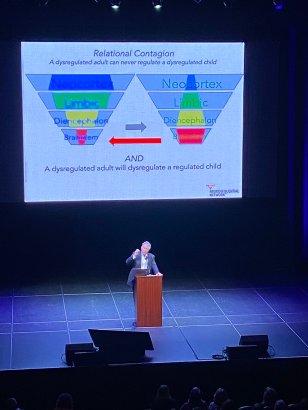
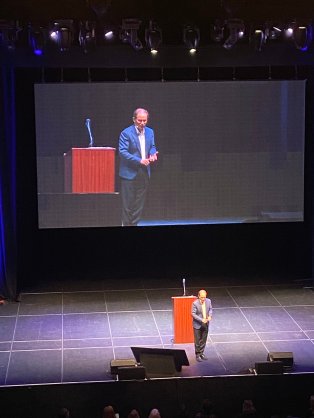
Throughout the conference I attempted to live-Tweet to my professional network some of the best sound bites. Many of my favourite take-aways were from one of the first keynotes, By Dr. Perry. Among them included:
“Our primary work in the classroom is to first regulate the child, or else you can’t connect with them. Humans are relational creatures.”
The key to a trauma-informed classroom is to recognize there needs to be differential dosing of curricular content based on the needs of the child.
“A regulated classroom is a rhythmic classroom and a relational classroom. If you stay calm, it will calm them (students) down.”
“Administrators need to think about instructional care models.” Because a dysregulated adult can never regulate a dysregulated child.
Dr. Perry’s talk hit many of the themes that would be highlighted throughout the conference, including that when we attend to the wellness of adults who care for children, we are better positioned to tend to the wellness of students, and that relationships are key to everything, including the personalization of learning.
Dr. Dan Siegel was also a highlight speaker for me, and I was pleased to have the opportunity hear him speak not once, but twice. As a neuropsychiatrist, I appreciated hearing from a perspective grounded in neural science. One of the key phrases he used was, “Where attention goes, neural firing flows and neural connection grows.” Essentially what this means is that the adolescent brain goes through a process of pruning some neural networks, and enhancing others by laying down myelin. We strengthen the neural networks we use, and lose those we don’t. The lesson for educators here is to encourage students in devoting their energies towards those networks they want to build and enhance; to pursue their areas of passion and routines that reinforce health and wellness.
One of the more amusing anecdotes was about the development of the teenage brain in comparison to other adolescent species. Dr. Siegel described how adolescent gazelles will also engage in risky behaviour by running up to their natural predators and then running away. While this may, on the surface, seem exceptionally foolish, Dr. Siegel explained that the ability to lead is enhanced when one has been to the precipice of danger and navigated back from it successfully.
Adolescence is also the time when many species begin pushing for their own independence, and look to leave the relative comfort of, what Dr. Siegel calls, “The Oatmeal House”. (The home where your parents prepare your oatmeal for you every morning! And do your laundry… and pay the bills, etc. etc). As adolescents prepare to leave the safety of the family collective, social acceptance among their peer group becomes vitally important; so much so that they will cave to peer pressure to gain it and may even act contrary to their values or morals. From a neuro-science perspective, however, this is actually a survival instinct; because without the safety of the group, those left on the outside looking in have their entire existence jeopardized.
Other gems from Dr. Siegel included:
The ‘3 Rs’ of Reading, Writing and Arithmetic are important, but it’s important to also teach the ‘new’ 3 Rs: Reflective skills, Relationship skills, Resilience skills. My colleague Brad Baker also suggested an additional R; ‘Respect’.
Defining what ‘integration’ means with respect to relationships and the brain. Integration is where different aspects of a system become linked, but don’t lose their uniqueness. Integrative relationships stimulate the growth of the integrated brain, leading to regulation and optimal health. Adversity, conversely, impairs brain integration.
The identification of ‘4 Ss’ that help promote an integrative brain and, by extension, health and well-being: Safety, being Seen (students need to noticed), Soothed (fears), Security (trust).
F.A.C.E.S. is an acronym used to characterize the features of wellbeing: Flexible, Adaptive, Coherence, Energized, Stable
Two other speakers I enjoyed listening to included Dr. Mona Delahooke’s talk on Using Brain Science to Reduce Anxiety, Toxic Stress, and Behavioural Challenges and Clay Cook’s breakout session on Teacher Stress & Wellbeing.
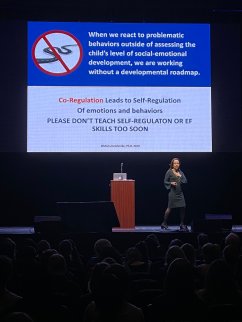
Dr. Delahooke, in her empathic approach, suggested that challenging student behaviours are an adaption to autonomic nervous system cues, and that there is a difference between wilful misbehaviour and a subconscious adaptation. The behaviours are only the metaphorical tip of the iceberg, and that it’s our responsibility in caring for our children to delve beyond the surface, seek to understand, and support students as best we can. I also appreciated Dr. Delahooke’s notion that self-regulation needs to begin first with co-regulation; that the external interaction between students in your classroom/building needs to be upskilled and regulated before attention can be turned inwards for students.
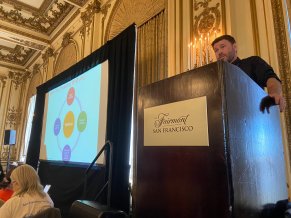
Clay Cook’s breakout session about Promoting Teacher’s Stress Reduction, Emotional Wellbeing, and Positive Social Interactions, really hammered home the theme that unwell adults have difficulty promoting well children. He also discussed how psychological safety for staff creates a collaborative and innovative learning culture, and that ‘climate’ is how people feel, while ‘culture’ is how people behave. Finally, Clay noted that high-performing environments and frequent ‘ratcheting-up’ of expectations for students are a potent risk factor for mental health disorders, just as other factors like poverty are. This idea gave me pause for reflection on how it is we can continue to maintain high expectations and the pursuit of excellence in our students, while simultaneously supporting their mental health and wellbeing.
Overall the conference was a wonderful learning experience, and I found the speakers to generally be highly engaging, knowledgeable and informative. My notes here represent only a handful of the many talented presenters we saw. In the end, I left having a better understanding of some of the latest science-based research supporting the work we’re already doing with our students around mental health and wellness, and a renewed appreciation for the commitment I have to building the best relationships I can both with and among my staff. Lastly, it was also a great opportunity to network with education professionals from the U.S., Canada and beyond. If you’re considering attending one of the bi-annual Learning and Brain Conferences in either San Francisco or New York, I would highly recommend that you do!
This month I had the privilege of participating in a professional development opportunity with a coaching and leadership organization called The Roy Group (http://www.roygroup.net) Twenty-one participants, including teachers and administrators, from Handsworth and Carson Graham Secondary gathered over an immersive 3 days to engage an experience called The Leader’s Discipline. This work was facilitated by Roy Group founder, Ian Chisholm as well as Carson Graham Principal, Ian Kennedy. Much of what we were to discover later was shrouded in a bit of mystery, but a few instructions we did receive beforehand included to clear our calendar for the event, to plan to leave our cell phone off and emails unattended, and finally to make sure we came prepared to discuss a professional problem of practice. Oh, and to dress for activity!
We began with a Wednesday evening dinner that brought the groups from both schools to break bread and build relationships in anticipation of Thursday and Friday. Each participant introduced themselves and talked a little bit about their learning intentions for the experience. Ian Chisholm, or ‘Chis’ as we called him, spoke a bit about his professional journey as well, and how it brought him to work with us today. A few of the aforementioned instructions were provided and we all left looking forward to the next day.
On Thursday morning we met at the North Shore Tennis Club on Lloyd Ave in North Vancouver. Although having lived in North Van for most of my life, I’d never actually been inside the facility, so it was neat to see. To begin the day we were each given a notebook, pen, and a series of custom stickers that included quotes, concepts and key ideas we would be working with throughout the day.
The first idea we played with was what it means to be a ‘mentor’; that a mentor is name you don’t give yourself – it needs to be given to you. We also discovered that the word ‘mentor’ is actually the name of the person Odysseus left his son, Telemachus, with before leaving for the Trojan war.
Our first activity, without giving away the details, was designed to illustrate how being an engaged and attentive listener is such an important skill. And that way we conduct ourselves has real effect on those we interact with.
It was from this activity that I knew what we were learning was going to be absolutely applicable to my daily work. Much of my day is comprised of brief 5 minute interactions with colleagues, parents and students. And my ability to be ‘dialed-in’ for each of those conversations has a significant impact on my effectiveness as support in my school. How you conduct yourself is so important. We learned that ‘conduct’ is where everything inside of you, meets everything outside of you, and the way I conduct myself creates an ‘atmosphere’ in others.
With colleagues in the school, it’s important that the atmosphere I’m creating is one of safety… but not comfort. Particularly with all the changes happening in education, it’s more important than ever that educational leaders are encouraging movement from comfort through discomfort – but from a place of safety. High performance professionals who are heavily engaged in their work are not comfortable.
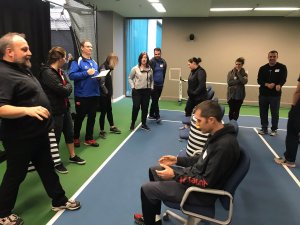
Through our second activity we started to explore what meaningful feedback looks like. We were partnered up to complete a task which involved tossing tennis balls from a seated position, and through multiple iterations discovered the relative value of encouragement versus detailed information as feedback. This is where we also began to examine coaching as a vehicle for feedback, mentorship and, ultimately, leadership.
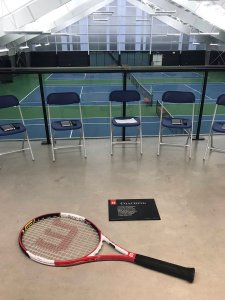
In the afternoon this understanding was further refined as we hit the tennis court to start using a coaching model for providing feedback. Chis kicked off the session with an intro to tennis pro turned philosopher Tim Gallwey. Gallwey is the author of The Inner Game of Tennis, a psychological examination of sport performance phenomenon. In it, he describes two selves: Self 1, which is analytical, ego-driven and gets in the way of Self 2, which is more unconscious, intuitive and physical. When an athlete is ‘in the zone’, they are fully realizing their Self 2 potential. The secret to the Inner Game is really to find how to get Self 1 out of the way of Self 2.
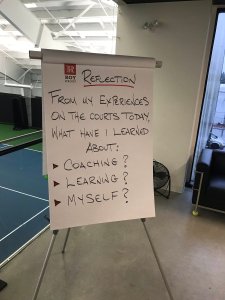
For the purposes of this activity, we participants were arranged in trios, with a coachee (player), coach, and super coach who would provide feedback to the coach on their performance. Coaches used something called The Question Funnel with their players; a series of questions designed to increase awareness and focus attention. Meanwhile, the super coaches who were observing the work of the coaches with the coachees followed The Feedback Model. This model employs three simple, but powerful questions: 1. What went well? 2. What was tricky?, and 3. What would you do differently next time? Once the coach had the opportunity to provide reflections of their own, then the supercoach was able to offer their thoughts. The ideas we had established earlier about quality feedback needing to be more informative than encouraging were also reinforced through this activity. We each had an opportunity to try all 3 roles, and from this activity I learned that as a coach/mentor it’s important to be highly attentive, to allow the student to define their own goals, and to remember that learning is a reflective process that works best when people feel safe.
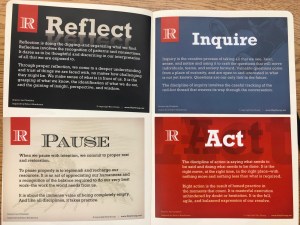
To wrap up a very full Thursday, Chis introduced us to ‘Henderson’s Disciplines’ – 4 ideas, that when combined together provide a powerful framework for decision making. They are: Reflect, Inquire, Pause and Act. Chis reminded us that reflection cannot be superficial – it must be rigorous to be useful. And that pausing really is important, despite how difficult many of us find it to do. And so for homework, we were challenged to carve out an authentic and meaningful pause; to take a break from the day, and to make a conscious effort to relax at some point between when we ended our Thursday and began our Friday. Unfortunately for the Handsworth participants this also happened to be our Parent-Teacher Interview evening. But needless to say, we did our best!
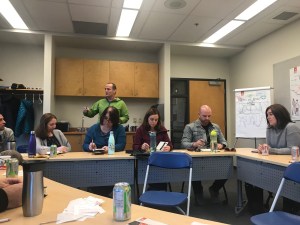
On Friday we moved locations from the tennis courts to a seminar room at a local rec centre. The focus for Friday was to take the theory and concepts we had learned, and bring them to bear on a real problem of practice we were dealing with. Essentially it was to bridge the theory with the real world and to make it explicitly applicable.
Our first activity was to form new trios of coachee, coach, and super-coach, but this time we weren’t refining tennis skills, but rather coaching our colleagues through real work issues. Ian and Chis provided us with an exemplar to start, and then we broke out in to different spaces to work. It was a wonderful opportunity to practice using these new tools we had just been equipped with, in a real world situation.
Another tool which was added to our belt to work through these issues was the GROW Model. GROW stands for Goal, Reality, Options and Will, and each category includes a series of questions to be used to drill down into a problem and help work towards a possible resolution.
As a coachee, it was insightful to have a coach who could take my issue in unanticipated directions with their questions. It forced me to examine it from a new perspective. I also noted that I didn’t need my coach to have all the answers – the coach is not going to be the source of the solution; they are just there to facilitate my own reflection and to take it in different directions.
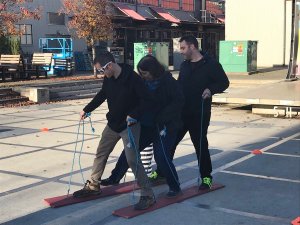
Our culminating activity for the day was an outdoor competitive group challenge. We were divided into 4 teams, each with a coach to help guide using the Question Funnel, and supercoach to employ The Feedback Model with the coach. Our team challenge was a timed obstacle course, and brought together many of the concepts we had already learned, including having the coachees (the team) determine their own goals. We were encouraged to practice our questioning techniques, rather than telling people what to do, and were reminded that leaders are able to check their emotions by grasping themselves, grasping their team, and finally grasping the task at hand.
As we wound down the experience and debriefed some of our takeaways, we discussed how leaders don’t create followers, they create other leaders. And that good coaching is really having the right conversation before, and having the right conversation after.
We were challenged to identify 10 topics we hope to be coached on, and by whom, and to write them down. Lastly, we set some tangible goals for ourselves, moving forward, and committed to practicing our new coaching and leadership skills in some way. For me, I’m pleased to say I’ve already brought these lessons to bear on my own practice by using The Feedback Model in conducting performance reviews. I also feel better equipped than ever to navigate some of the complex relationships and difficult conversations I regularly encounter in my role.
This was a wonderful professional development experience, and I would highly recommend it for anyone in a position of leadership, or who works in a highly relational industry. It was great to have the chance to work with the team from Carson Graham as well. I’m looking forward to integrating these skills even more into my daily work, as I know they’ll serve me well. Thanks to Ian Chisholm, Ian Kennedy and the Handsworth and Carson Graham teams.
This month I had the privilege of attending the BCPVPA Short Course I, held at UBC from July 3 – 7. This week-long intensive course is designed to provide new and early-career school leaders with the opportunity to refine their leadership skills and connect and network with other like-minded professionals at similar stages in their profession. I’m sometimes asked by budding school leaders, or those who are in the role, but never took the opportunity what Short Course I is all about. So here it is.
For the 41st edition of Short Course I, we had assembled the largest group educational leaders ever to attend this program. This year’s theme was “Leading Learning: Thriving in a Time of Innovation and Change”. Each day, the course focused on a different domain from the Leadership Standards for Principals & Vice-Principals in British Columbia. In the following I break down just some of the highlights of what was covered each day.
Short Course Day 1
Day 1 revolved around Moral Stewardship.
Sweet 16!
830AM We met in our pre-determined ‘family’ groups, each chaired by a veteran facilitator who had been to Short Course before. I was at table 16 and my facilitator, Anne Smith, was a Principal from Ecole Lac des Bois in Prince George. Anne had already played this role a number of time previously and I could tell from her enthusiasm and confidence that she was going to be a wonderful facilitator! Our team had to come up with a team name, and I whimsically suggested “Sweet 16” because Anne had brought a bunch of candy for our table, and it stuck. Team Sweet 16 was formed!
915AM After some table talk, we were given a formal welcome to UBC by Blye Frank, the Dean of Education. Mr. Frank reminded us that when doing traditional acknowledgements at our schools, that we are not in a position to welcome our staff and students to traditional territories, that was are only permitted to acknowledge where we work, play and live. An important distinction, to be sure.
Our Co-Directors for the conference, Liz Bell and Jessica Antosz, as well as Kim Maxwell, the BCPVPA Professional Learning Senior Assistant, were introduced. I was fortunate to already know Liz from her great work previously in the North Vancouver School District. They set us up with what the structure would be for the week, and discussed some of what we’d need to know – everything from the philosophy and vision of the short course to tech access and where our break out rooms would be located.
945AM The Superintendent of Schools in Vancouver, Suzanne Hoffman, spoke to us about Passion For Leadership. A few highlights I took from this talk revolved around modeling leadership – ‘show, don’t tell’, and to lead humbly which is something I try to emulate in servant leadership. One of her most quotable questions was about, “what is your flagship?”, meaning what is the one thing you’re known for around your school community. She gave the group a moment to reflect when asking if we could name off all of our students who are in care, or who are indigenous. And finally she reminded me of a book I’ve meaning to read – Carol Dwecks, “Mindset: The New Psychology of Success”, where she discusses having a ‘growth mindset’.
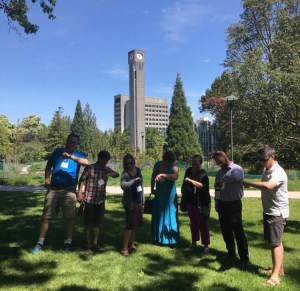
11:20AM Our family groups engaged in a team building exercise called a ‘Goose Chase’. This was essentially a scavenger hunt around UBC where we had to take photos of our group doing funny poses in different areas after figuring out clues. Teams were finishing the challenges so quickly, that more had to be added while we were playing. Our team ended up finishing 3rd out of 25 teams! It was fun to see the other team’s photos posted on the activity feed in the app throughout. I’m contemplating doing it with our staff around Handsworth during the first week back in September.
Completing a Goose Chase challengeScott MacDonald speaks about student success
12:00PM Lunch each day was provided by UBC catering and was outstanding!
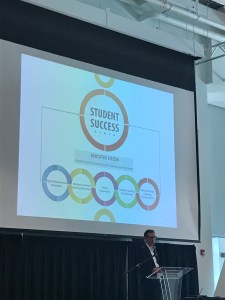
12:45PM BC’s Assistant Deputy Minister of Education, Scott Macdonald, spoke with us about data driven decision making in BC’s education system. He highlighted that high performing schools have high performing administrators, but also recognized that energies are not limitless and when we’re considering where to apply them to think about some measurables like graduation rates. He also had some interesting statistical comments about students who are December babies, versus students who are January babies and what some strategies might be to mitigate the differences between birth months in the same grade.
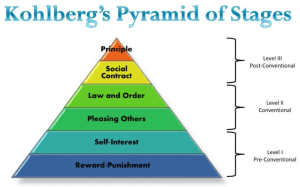
1:30PM Liz Bell and Kevin Fadum facilitated a session on ‘Decision Making’, giving us a process by which we could reflect on how we make our decisions, and what values those decisions are grounded in. Kohlberg’s pyramid of stages was referenced in discussion what motivates people, particularly when interests are competing. We discussed values, morals and ethics and look at analyzing ‘Right VS Right’ dilemmas where clear-cut answers were not always obvious.
3:45PM Our afternoons were spent each day unpacking with our family groups reflections from the day. Around 4:30 we broke for the day, save for the large number of folks who stuck around for the evening Ignite session in the UBC Nest patio.
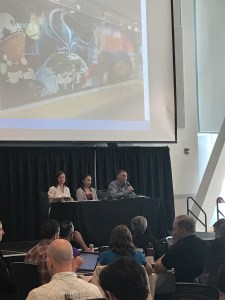
Speaking at the Ignite event
5:00PM In the evening, New Westminster Principal John Tyler organized an Ignite session. Ignite talks are similar to Ted Talks in that they are structured talks delivered by presenters with accompanying visuals. An Ignite, specifically, is exactly 5 minutes long consisting of 20 slides timed to run at 15 second each. I was one of 5 presenters to speak during the Ignite session, talking about my first year as a Vice Principal. Much of the content of what I spoke about was taken from my blog entry, ‘My First 100 Days’. A big thanks to my colleagues from North Van, Jeeniece, Jillian and Brigette, who were also at Short Course and stayed to support me.
Day 2’s theme was Instructional Leadership
Bruce Beairsto discusses leadership
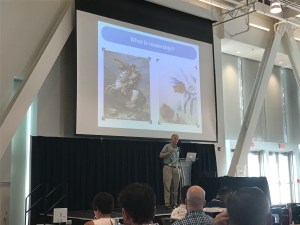
9:00 Our first speaker of the day was the former Superintendent of Richmond Schools, Bruce Beairsto. His topic, broadly, was instructional leadership, but specifically how do we lead learning. His use of the male / female archetype when discussing leadership styles and the accompanying images of Napoleon and Mother Theresa gave the group pause for thought and fodder for discussion later in the day. Mr. Beairsto compared influence versus authority, commitment versus compliance and inspiration versus instruction when discussing influential leadership against management authority. He also defined professional autonomy for us, emphasizing what ‘professional’ really means – a voluntary adherence to a high ethical standard of expectations.
11:00 – 12:30 / 1:30 – 3:00 The majority of our day today was dominated by two different breakout sessions. Each session focused on a different aspect of Instructional Leadership. The intent was to have a different member from each family grouping attending a different session so that all would be covered and the learnings could be reported back to the group for mutual benefit. The only drawback to this was that I found myself in the same sessions as some of my North Vancouver colleagues, and we had intended on similarly distributing our time across the sessions for mutual benefit, but it didn’t end up working that way due to our family group obligations. We also didn’t get the chance to support our North Van colleague, Rob Smyth, at his session on Understanding the Why: Leading and Learning in Aboriginal Education.
The first session I attended in the morning was called Working in a Unionized Work Place and was led by Kevin Fadum, and Debbie Craig. After all the attendees introduced themselves and their work context, Kevin and Debbie walked us through understanding collective agreements – both provincial and local language. We talked about management rights and responsibilities. Unfortunately we ran out of time before getting through all the content that was prepared for us, but what we did cover was extremely informative.
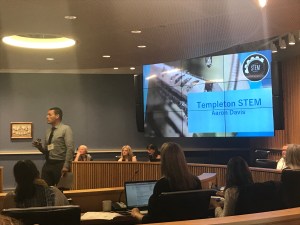
Aaron Davis speaks about Templeton STEM
The second session I attended in the afternoon was in the Kingsmill Forum, a fancy round seminar room that looked sort of like a city hall chamber. Here I listened to a panel of speakers talk about Leading the Redesigned Curriculum. After an overview discussion about how to effectively lead change, we delved deep into 4 different examples – 2 from elementary and 2 from secondary – of school leaders examples of employing new curriculum. The secondary examples, which were most relevant to me were 1) Aaron Davis, VSB Director of Instruction, speaking about Templeton’s STEM Program, and 2) Pedro Da Silva, also a VSB Director of Instruction, sharing the certificate program used at John Oliver Secondary. During this session I also had a great chat with one of my family group members, Mike Moloney, VP at Panorama Ridge Secondary, about using of course outlines as one way to gauge successful implementation of new curriculum. If teachers are successfully using the new curriculum, it should be evident in what they’re assessing, which would ideally also be described in their outlines.
Day 3 was all about Relational Leadership.
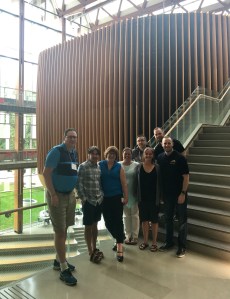
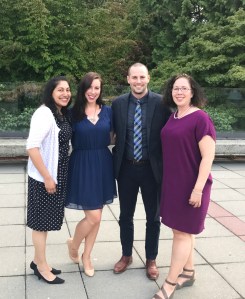
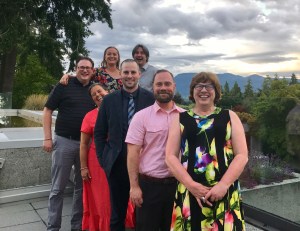
My fellow North Van Short Coursers!
We began the day with a unique welcome from a Tibetan horn. One of the major pieces of today was all about First People’s perspectives – ways of knowing and learning. We were welcomed by Elder Roberta Price of the Coast Salish People, who shared some personal stories with us.
9:00 – 10:30 Our first session on Aboriginal Education was titled Understanding the Why: Leading and Learning in Aboriginal Education and was led by Brandon Curr, District Principal for Indigenous Education in Burnaby, and our own Rob Smyth, Norgate Elementary Principal, from North Vancouver. The speakers encouraged us, especially, to make sure we were connecting with our local aboriginal groups to ensure their voices were being heard. To describe our fluency, appreciation and use of First People’s principles in education, a metaphor of piloting a canoe was used. Some of us are just at the stage where we are carrying the canoe to water, while others are fully immersed, piloting in deep waters. Three questions that help guide our discussion included: 1. What are your experiences with aboriginal worldviews and experiences? 2. What reservations or doubts do you have about journeying into deeper waters with aboriginal worldviews and perspectives? 3. What commitment can you make to journey into deeper water with aboriginal worldviews and perspectives? During this session, there was also mention made of a North Van canoe and kayak tour operator named Takaya Tours. I know other schools in our district, as well as our school board, have taken staff on such an experience, and it occurred to me that this might be a great idea for our staff some time in the next year.
Calls to Action Panel Discussion
11:00 – 12:30 After break, Terry Beaudry, Deputy Superintendent of Schools in the Central Okanagan, facilitated a panel discussion on Our Calls to Action – Truth and Reconciliation. I really liked Rob Smyth’s open question, asking us to look beyond our professional work and to contemplate what is our personal call to action when it comes to reconciliation. As I’ve been working on our school plan the last couple of years, I was reflecting during this discussion about ways I could more meaningfully incorporate aboriginal perspectives into the plan. We’re also in the midst of planning a rebuild of Handsworth, and I like the idea that signage, such as bathrooms, could be posted in local aboriginal language. Our school theme for next year is going to be “Building Connections” and everything I heard during the panel discussion certainly spoke to that theme. The best quote to summarize the discussion would probably be, “Watch, listen, & show respect.”
1:15 – 2:45 In the afternoon, Maeve Buckley, a retired principal and leadership coach from the Central Okanagan, ran a session on leadership with us. She kicked off her session with an energic round of group sing to the song RESPECT, and carried this theme through her presentation as she used the same word, respect, as an acronym for leadership elements. We looked at different types of leadership styles, and watched an interesting clip on ‘Presence & The Drama Triangle’.
Maeve commented on the importance of self-awareness and self-reflection as a factor that predicates success as a leader, and it gave me a heightened appreciation for the reflective blogging I do! She also reminded us to speak positively, and that the absence of negative talk is only neutral, not positive. The main activity we participated in was a 4 corners activity where we were asked to consider which type of boat represented how was navigated change – a speed boat, sail boat, kayak or cruise ship. As we went around the room justifying our choices, there were some very interesting rationale; everything from how easy or difficult altering course was, to how many people could be brought along successfully with the change, or to what motivate or powered the boat’s change in direction. The boat was certainly an apt metaphor!
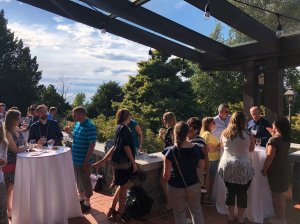
Enjoying refreshments at Cecil Green House
We wrapped the formal portion of the day a debrief with our family groups and facilitator before heading home or to our hotel to prep for the evening social. Today’s social was a wine and cheese event sponsored by the BCPVPA legal team and hosted by UBC / BCPVPA staff at Cecil Green House.
Day 4’s theme was Organizational Leadership and we began the day organized a little differently – this time in our ‘affinity groups’. These groups better represented the context we worked in – elementary or secondary, size of school, French immersion, alternate school, etc. The idea was to work today with folks who we were more likely to share a similar context with so we could, perhaps, relate better on the issues discussed throughout the day. During this morning, I got to meet another fellow VP from Sea to Sky, Jenelle Kresak.
Legal and Contract Services Panel Discussion
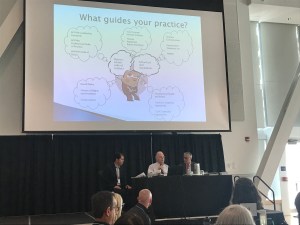
Today was a lot of ‘legal stuff’ and understand roles, responsibilities, and what guides our practice as administrators. Our BCPVPA Legal and Contract services team was on hand to deliver a presentation, and supporting them was Allen Soltan of DLA Piper, LLP. Some of the topics covered included:
How the Law views the role of the Principal & Vice Principal
Guiding frameworks for practice (School Act, District Policy, TRB Standards, etc, etc)
Duties / Responsibilities of Principals & Vice Principals
Case Studies around social media use, duty to supervise
Use of force / restraint
Privacy / Access to Information
Workplace Bullying / Harassment & Discrimination
Elements of a personal services contract & benefits
Negotiation Agency of the BCPVPA
It was great to have bona fide legal advice on hand for the session to answer questions from our group. If I had a tip for next year’s group I’d say have all your burning legal questions ready to fire for this day.
Because we were organized in our Affinity Groups this day, we also had some great table talk with people in similar contexts. We also got a first peek at a phenomenal new resources for Principals and Vice Principals called the BCPVPA Start Smart Planning Guide.
Start Smart Planning Guide
While there’s no ‘how to’ manual for how to be an administrator, this new resource covers a lot of topics for new admin who may not even know what questions to ask or where to start. It’s being polished up and will be shared more widely soon, so keep your eyes out for it.
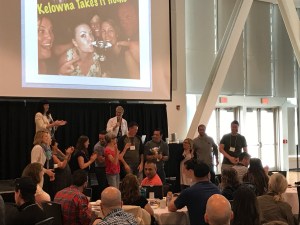
Kelowna claims their prize
Friday, Day 4 was also the day of our evening banquet held at Sage Bistro. We had a few speeches from guests, spent time and took photos with our family groups and even had a dance competition. And despite a strong showing from Prince George, and an unnamed city who pre-emptively put their names on the trophy, it was Kelowna who ended up winning the dance competition by being the town with the last members standing on the dance floor at the end of the night. It was also nice during this evening to reconnect with my colleagues from North Van to check in and see how their experience at short course had been going so far.
Sweet 16 at Sage Bistro
To finish out the week, Saturday’s theme was “Inspiration to Lead”. We started a bit earlier as breakfast was provided this morning. Our family groups gathered once more to start to the day, and we began once more with reflections on yesterday’s learnings.
9:00 – 10:00 Our first speaker for Saturday was Pat Duncan, Superintendent of Learning with the Ministry of Education. Pat had given brief words of welcome at the previous night’s dinner, but today we really got to hear some detailed information from him on behalf of the ministry. He introduced himself first and foremost proudly as a teacher, and in doing so reminded us never to forget that’s what we are. His main purpose was to talk about the new BC curriculum and the WHY behind it all. He took us through the origins of its creation and some of the guiding questions that drove the process, including “What is worth learning?” He encouraged us to imagine teachers as coaches, mentors and activators, not the keepers of knowledge. And that being good at work sheets and memorization are not top skills for students entering the workforce. To demonstrate the difference between knowledge and understanding, Pat showed us a great clip about the Backwards Bicycle.
11:00 – 11:20 David DeRosa, the new President of the BCPVPA gave a brief talk on leadership, focusing on health, wellness and balance, giving a background of the BCPVPA and encouraging members to be involved in committees like chapter council and the issues forum. Something to consider in the future for sure!
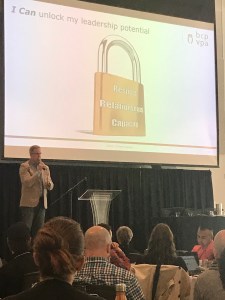
Kevin Reimer speaking about leadership potential
11:20 – 11:40 Our final formal presentation of the week came from Kevin Reimer, our outgoing President of the BCPVPA as well as the incoming Executive Director. Kevin’s talk was titled ‘Learning, Leading and Laughing’, with the tongue-in-cheek subtitle ‘Learning from Kevin’s Many Leadership Mistakes’. He told us a wonderful story about a school he worked with in Comox who made their theme for the year “We Can”, and picked a theme song by a relatively unknown artist named Jesse Ruben. Jesse ended up coming to visit the school to shoot a music video with the school, and his work supporting students through the ‘We Can’ project spread from there! Kevin also talked about the importance of credibility, and the need to re-establish it at every new school you work at, and contrasted the difference between deep influential power versus authoritative, ‘cheap’ power. His final piece of inspiration was a quote he keeps on a post-it note on his computer monitor, to “Increase the Life Chances of Every Child” – and this should be our focus every day!
A thank you for our facilitator, Anne Smith
Short Course I was an inspiring, engaging (and exhausting!) full week experience of professional development. In the end, I would highly recommend it for any administrators who are early in their career. I think it was definitely valuable to have experiences to draw on, particularly during discussion times, so with that in mind I’d suggest that if you’ve never actually worked as a VP or P, it would be a conference better attended after you’ve spend a year in the role. The conference runs much longer than a typical day, so be prepared to spend your evenings out as well. I know many of the participants, particularly those from out of town, ended up staying at UBC in some of the rental housing, which is a great idea. Beyond the learnings and tools for the toolbelt, I just really enjoyed networking with a large group of people who were at a similar stage in their roles as administrators. You can never have a large enough support network for a role like this, and having people in other districts with a detached, informed and unique perspective on issues you may handle in the role is such an asset. A big thank you to organizers Liz, Jessica and Kim, and to our fabulous Group 16 facilitator, Anne! If you’ve attended a Short Course and have some perspective to add, please feel free to add your comments in the space below.
Last week eleven of my colleagues and I had the privilege of traveling to High Tech High in San Diego, California for a transformative professional development experience. High Tech High is a collection of charter schools whose students are admitted by a zip code based lottery designed to draw students who demographically reflect the diversity of the surrounding San Diego county. “High Tech High” is a bit of a misnomer, because although the school incorporates technology in a variety of ways into the classroom, technology is not the focus. High Tech High focuses rather on using project-based learning (PBL) to enhance student engagement and achievement.
What is PBL?
PBL is a constructivist approach to teaching that involves student-centered instruction through assigning purposeful activities and projects. It allows students to work more autonomously to construct their own learning, and culminates in realistic, student-generated products. While the projects are the product, the processes by which the students arrive at that product are far more important. Teachers use scaffolding, elements of design thinking, front-load students with essential understandings and develop inquiry questions to be answered before the conclusion of the project. PBL proponents understand that student knowledge is constructed, not transmitted and work to build a reflective understanding of the project development experience.
The 2017 Winter Residency
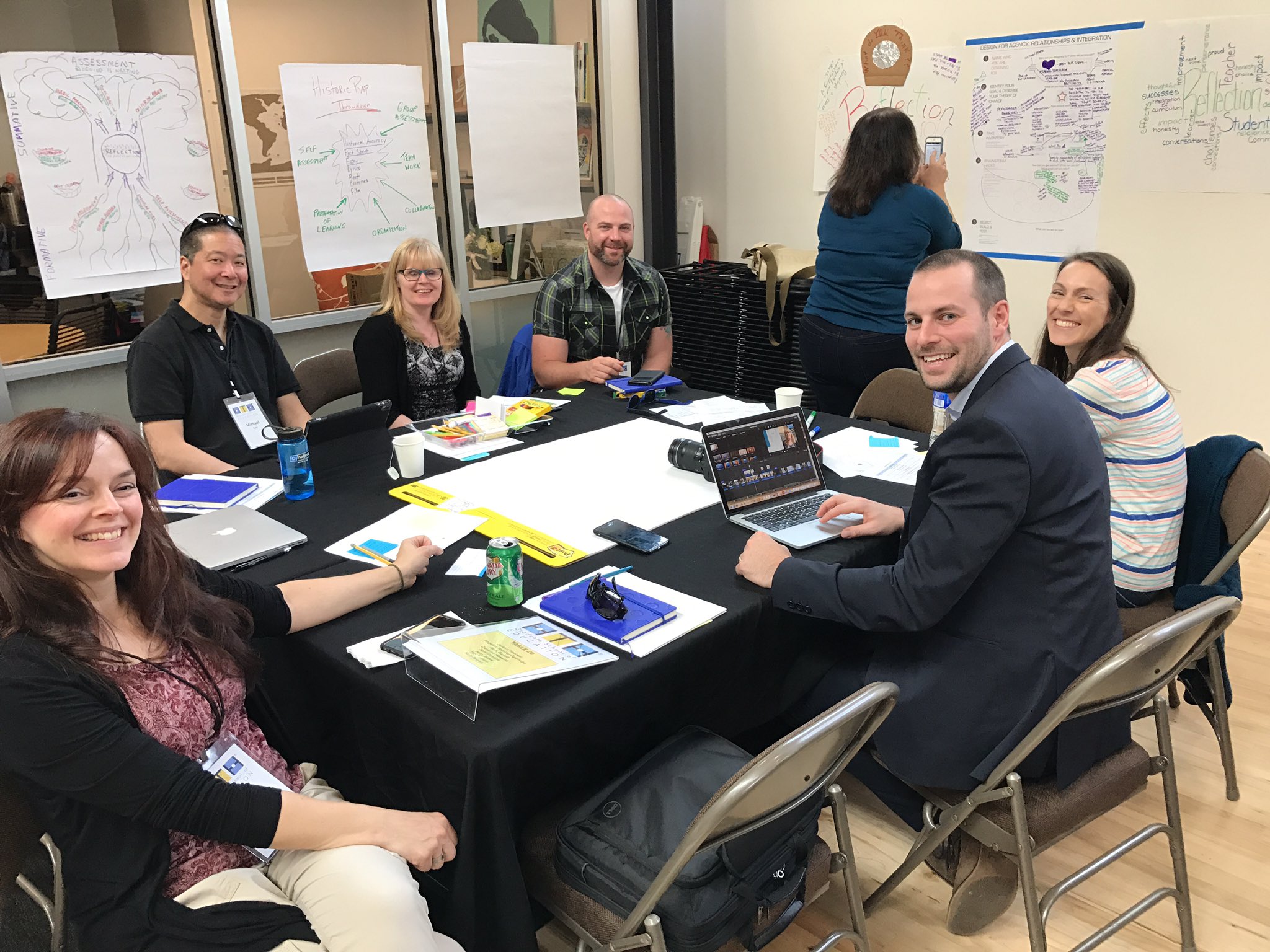
Over the course of our three days at the HTH Winter Residency, participants worked to refine their understand of PBL through activities and discussion. Our group came well prepared with existing projects and ideas we were looking to refine and tune. Some of the major initiatives we’ve been working on at our school include our ‘Innovation Wednesdays’ and a possible school wide project to celebrate Canada’s 150th anniversary. Individual teachers also had inquiry questions and class projects they brought to HTH to tune up and reflect upon with colleagues from around the US and Canada.
Two of the most valuable and rewarding aspects over the three days of the residency I found were the opportunity to explore the campus and to interview current HTH students.
I’ve always been interested in the intersection between form and function and specifically in a school how its physical space influences the style of instruction. The classrooms of HTH have enormous windows giving visitors like us the opportunity to peer in and easily see what’s happening. Students work in rooms where desks are arranged in circles or small groups for more collaboration. Transparency is seen not only in the generous windows, but also in how student work is displayed throughout the interior of the buildings. There were visual displays of learning around the schools including murals, exhibitions and even science demonstrations that could fit in a classroom windowpane.
Making learning visible is a consistent theme, and was achieved primarily through three methods; firstly, the aforementioned exhibitions of work, secondly through presentations of learning, and thirdly though student-led conferences. During student conferences, students would address what they are learning and why, how they’re successful, what challenges them, how they’re doing as an individual learner and how they’re doing within the broader learning community. Conferences are mediated with a curated selection of student work the provided authentic evidence.
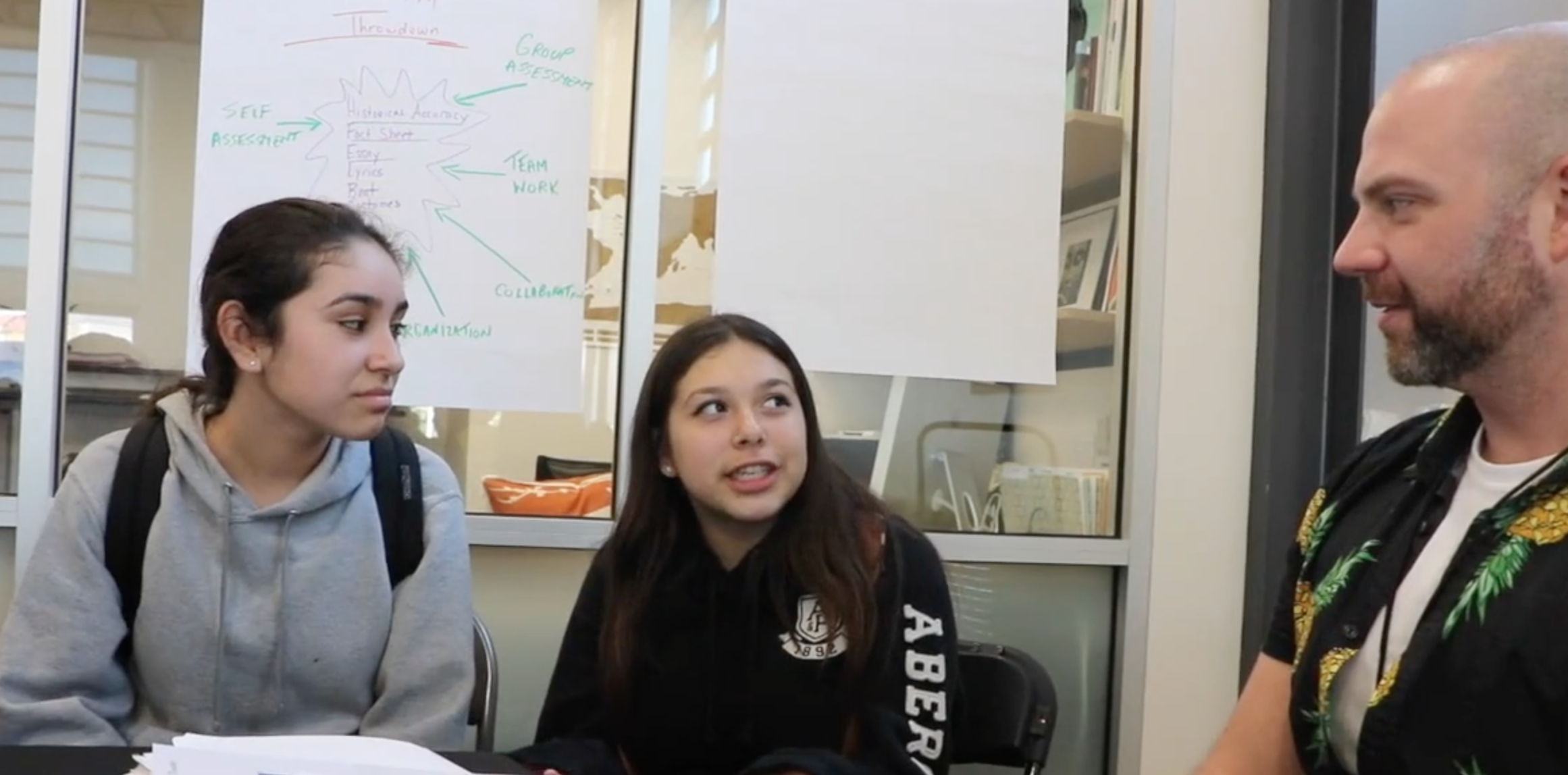
The opportunity to speak with current HTH students was also immensely insightful. All the students we spoke with were incredibly articulate and able to express quite thoughtfully their experience at the school. They all seemed very aware of what a special place it was they were attending, and how lucky they were to have been chosen by lottery. Student performance seemed to be buoyed both by the fact their work is constantly exhibited, and because they knew the opportunity they had been afforded was one coveted by many other students. In my discussions with the students I tried to dig deeper into any perceived shortcomings of their experience, to take a more critical look at anything HTH could be doing better with their project-based approach. One of the aspects the students lamented was that they didn’t have many of the conventional extra-curricular experiences like sports teams or school dances other schools were more likely to have. Any shortcomings, however, paled in comparison to the educational opportunities made possible by going to HTH, including the remarkable post-secondary enrolment rates.
Dr. Kaleb Rashad
The other truly inspiring piece of the Winter Residency was the chance to hear the new Director of High Tech High, Dr. Kaleb Rashad, speak. He was both the keynote speaker and also provided a Q&A session at the end of the three days. He encouraged us to look for inspiration during our time, and not simply to try and imitate what they were doing. Dr. Rashad had a lot to say about leadership, both from a theoretical and practical perspective. His mantra was to “love your people” and that in doing so, they would feel empowered to do “badass work!” When asked what he looked for with respect to instruction when sitting in a typical HTH class, he said that students should be engaging first in divergent, convergent, and then reflective thinking processes. When it comes to Pro-D he suggested we should always be modeling for teachers what we want them to do in their classes – avoid stand and deliver professional development experiences! Dr. Rashad has had a variety of educational leadership experiences, and throughout all of them it is evident he’s worked hard to build positive relationships and an inclusive and supportive school culture. To that end, he’s introduced something he calls ‘open mic’, where he makes an effort to sit for 10 minutes at the start of the year with each and every staff member to listen closely to his or her concerns without judgement. Anything said in those meetings is always shared in confidence. Dr. Rashad urged us to build trust and show people you love them – and that your staff, in turn, will also trust and love each other. One of the best ways to do this was via what he called “the two P’s”: permission and policies. Give your staff permission to dream big – to go for it and try something new and innovative and have them feel supported. And the second “P” is policies. An educational leader should work to get the rules and policies out of the way stop people from doing amazing work. Reducing those barriers will help cultivate a positive school culture and make great things happen for students.
Documenting the Process
Part of my process in attending the Winter Residency was to document the journey of my North Vancouver colleagues. I made an effort throughout the three days to grab as many sound bites and video clips as I could to stitch together at the conclusion of our time together. I’m pretty self-critical, so the finished product is never as good as I’d wish, but I was really happy that in documenting our experience I got to celebrate my colleagues’ experience and all the wonderful reflections they had. If building collegial trust and relationships is considered a vital piece of positive school culture, we certainly checked that box off on this trip. Spending four full and intense days together was a wonderful way for us to bond, and I know we’re stronger as a staff for having taken so many people down with us. I have to thank our school board for being so supportive of this experience in allowing us to go. This video also helps validate the professional growth we were all hoping to gain by attending.
Take-Aways
There were so many take-aways from this experience from project-tuning major school projects like “Innovation Wednesdays” & “Canada 150”, to speaking with students and exploring the campus, to reflecting on educational leadership and connecting with colleagues. This was truly a transformative professional development experience. For Handsworth staff, all of these take-aways were wrapped in the over-arching goal of increasing student engagement. Our first week back at Handsworth has already been influenced by our time away. Staff met this week to introduce a student leadership course to bring new student voice opportunities to our school and to help shape version 2.0 of Innovation Wednesdays. Our Canada 150 project has a small working group who will start drafting details for our staff. Each staff member who came on the experience had to commit to refining one piece of his or her practice, and for me it’s all about how I make student learning more visible. One of things I was reminded of while at HTH was that students raise their performance when they know their work is going to be public. It becomes less about the marks and more about the quality of the work itself. Look for me to be sharing more student work in the future via social media and in exhibitions around the school. Thanks to HTH and to SD44 for a wonderful experience.
 Dr. Delahooke, in her empathic approach, suggested that challenging student behaviours are an adaption to autonomic nervous system cues, and that there is a difference between wilful misbehaviour and a subconscious adaptation. The behaviours are only the metaphorical tip of the iceberg, and that it’s our responsibility in caring for our children to delve beyond the surface, seek to understand, and support students as best we can. I also appreciated Dr. Delahooke’s notion that self-regulation needs to begin first with co-regulation; that the external interaction between students in your classroom/building needs to be upskilled and regulated before attention can be turned inwards for students.
 Clay Cook’s breakout session about Promoting Teacher’s Stress Reduction, Emotional Wellbeing, and Positive Social Interactions, really hammered home the theme that unwell adults have difficulty promoting well children. He also discussed how psychological safety for staff creates a collaborative and innovative learning culture, and that ‘climate’ is how people feel, while ‘culture’ is how people behave. Finally, Clay noted that high-performing environments and frequent ‘ratcheting-up’ of expectations for students are a potent risk factor for mental health disorders, just as other factors like poverty are. This idea gave me pause for reflection on how it is we can continue to maintain high expectations and the pursuit of excellence in our students, while simultaneously supporting their mental health and wellbeing.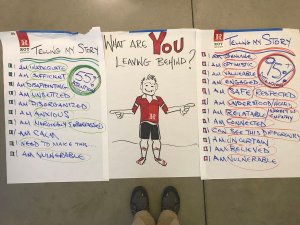
 Through our second activity we started to explore what meaningful feedback looks like. We were partnered up to complete a task which involved tossing tennis balls from a seated position, and through multiple iterations discovered the relative value of encouragement versus detailed information as feedback. This is where we also began to examine coaching as a vehicle for feedback, mentorship and, ultimately, leadership.
 In the afternoon this understanding was further refined as we hit the tennis court to start using a coaching model for providing feedback. Chis kicked off the session with an intro to tennis pro turned philosopher Tim Gallwey. Gallwey is the author of The Inner Game of Tennis, a psychological examination of sport performance phenomenon. In it, he describes two selves: Self 1, which is analytical, ego-driven and gets in the way of Self 2, which is more unconscious, intuitive and physical. When an athlete is ‘in the zone’, they are fully realizing their Self 2 potential. The secret to the Inner Game is really to find how to get Self 1 out of the way of Self 2.
 The ideas we had established earlier about quality feedback needing to be more informative than encouraging were also reinforced through this activity. We each had an opportunity to try all 3 roles, and from this activity I learned that as a coach/mentor it’s important to be highly attentive, to allow the student to define their own goals, and to remember that learning is a reflective process that works best when people feel safe.
 And so for homework, we were challenged to carve out an authentic and meaningful pause; to take a break from the day, and to make a conscious effort to relax at some point between when we ended our Thursday and began our Friday. Unfortunately for the Handsworth participants this also happened to be our Parent-Teacher Interview evening. But needless to say, we did our best!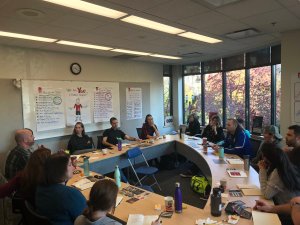
 Our culminating activity for the day was an outdoor competitive group challenge. We were divided into 4 teams, each with a coach to help guide using the Question Funnel, and supercoach to employ The Feedback Model with the coach. Our team challenge was a timed obstacle course, and brought together many of the concepts we had already learned, including having the coachees (the team) determine their own goals. We were encouraged to practice our questioning techniques, rather than telling people what to do, and were reminded that leaders are able to check their emotions by grasping themselves, grasping their team, and finally grasping the task at hand.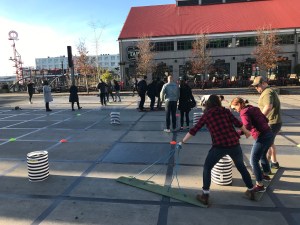


 Education Rumination
You must be logged in to post a comment.