The winter break marks roughly the first 100 days in my role as Vice Principal at Handsworth. Without having any frame of reference from past years, I still think it’s safe to say it was a remarkably busy beginning to the school year.
Preparations for the 2017/2018 school year had already began long before I took on my role. Building the school timetable, student course selections and preparations for school wide events for the year had already begun in earnest during the previous school year. One of the first challenges was to try and pick up work that had already began by others and to carry through and compliment it where possible. I spent part of July, and much of August making sure everything was in place for our massive 350 student Grade 8 Retreat. That event, combined with welcome preparations for our annual Japan Exchange, filled my plate with event planning.
The other major piece before the start of the school year was staffing. The restoration of class size and composition language in the BC teachers’ contract meant that more staff would need to be hired to start the year. That, combined with leaves and retirements, gave us about 20 new staff members to start the year. It took a few weeks in July, and every day leading up to the start of the school year before we were able to staff the school to meet the needs of our students. We were actually fortunate we were able to (almost) fill all of our positions before start-up. I know many other schools, especially in other districts, began the year severely short-staffed, and in some cases, still have positions unfilled.
The challenges to start the year were complex and varied. Operationally speaking we had staffing shortages, new orders for reporting on student learning, and the introduction of the new BC curriculum for grade 8 and 9. Decreasing class sizes necessitated recapturing teacher preparation areas from the school to convert them into instructional spaces. This meant some difficult conversations with people being displaced from areas of the school they were accustomed to working in, and having the unfortunate circumstance of some folks needing to work in upwards of 6 different spaces in the school. Certainly not ideal. Other school based challenges include ongoing student discipline, working to support our vibrant arts and athletics programs, and the continuing restructuring of spaces and supports to better accommodate the varied needs of our students, particularly our complex learners.
I’m very fortunate to be working this year with such a strong admin team. Our other VP was already working at Handsworth and provided some administrative continuity. And our new Principal has moved from the Vancouver School District to Handsworth and brings a wealth of experience and perspective that is refreshing. Plus, they’re just really great people! And I’d be remiss if I didn’t also mention how outstanding the ‘extended’ administrative team is. We work so closely with our front office staff, supervision, and counseling department on a daily basis, and their amazing work is so integral for us to be able to do our job well.
One of the great positives of my new role is that I now have a wider professional network in the district on which I can rely. All the administrators in our sister high-schools and family of elementary schools, as well as our directors and upper executive are always only a phone call away should we need their advice or assistance. Having a broader, district perspective is also important so I can stay in tune with the direction the district is moving when it comes to things like specialty district programs, aboriginal education and other emerging initiatives.
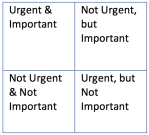
From my colleagues, I’ve learned not to get overwhelmed by the ‘tyranny of the urgent’. Some days I finish with more unread emails than I started the day with. And each and every person who comes through my office door throughout the day is there to share what their most pressing issue is at the moment. Providing an attentive and supportive ear is always needed. Admittedly, it can be difficult when conversation 1 is about a student in an emotional family crisis and, 5 minutes after, conversation 2 is with a staff member concerned their classroom is a bit too warm. Arguably the biggest part of the job is relationship building, and having people feel like they’re being heard, regardless of how big or small the issue is, is a huge part of that. One of the tools I’ve added to my belt is prioritizing responses. Emergent issues are classified in one of 4 ways: ‘urgent & important’, ‘not urgent, but important, ‘urgent, but not that important’, ‘not urgent & not important’. Clearly things that are ‘urgent & important’ are priority 1, and things that are ‘not urgent & not important’ can wait until later. This reduces the list of immediate ‘to-dos’ significantly during the work day.
Relational trust is, indeed, one of the most important aspects of any leadership position, and I’m very fortunate to get to still work at the school where I’ve established some great relationships with staff. But relationships are like a garden, and its takes continued time, care and attention to make sure they’re positive. Difficult conversations are certainly easier to have when you have an established positive, trusting rapport with a colleague. Having that relational piece already in place has allowed me to focus on learning more of the ‘nuts and bolts’ of the job. To begin the year, I didn’t know what I didn’t know. As Donald Rumsfeld once said, there are such things as ‘unknown unknowns’. For example, having never taught a French Immersion class, I didn’t know how many FI credits students needed to get a dual dogwood. There were also ‘known unknowns’. I had also never built a school timetable, or used the administrator interface on MyEd. Relational trust has given me the space to focus on learning what I previously didn’t know.
My decade of work at Handsworth did, however, provide me with an existing understanding of how many of the programs at our school do work. Nowhere has this been more evident than in athletics, as I served previously for 4 years as our school’s Athletic Director. Disappointingly, this year also marks the first year I won’t be coaching basketball in 12 years. I do really miss coaching, and hope I can return to it once I’m better accustomed to the rhythm of the administrative calendar. I also miss my classroom and being able to teach about what I’m passionate about. I loved my business classes, and know I had many students who also found their passion in business by taking courses with me. My hope now is that in my new role that I can inspire more students and staff on a broader scale to engage in what they’re passionate about, and to take what excited me in the classroom about business and try to bring it out in other ways in the school.
Being a school-based administrator is an incredibly complex job. We have over 1600 people working in our building every day. In the business world, our school alone would be considered a ‘large’ business. There’s something new to deal with each day, whether its operational items like hiring and evaluations, organizing school wide events like Remembrance Day assemblies and parent teacher interviews, completing ministry requirements for tracking student data for school funding, overseeing school budgets, occupational health and safety, navigating the complex layers of managing a unionized work environment, supporting the social-emotional needs of students and staff, working with facilities on maintaining or transforming spaces, meeting with parents, covering classes for staff, or spearheading educational leadership initiatives. The list goes on! Amidst all the chaos of the day, it’s good to be constantly reminded that students need to be at the centre of all our decisions, and that if we’re framing all our choices by the greatest good for the greatest number of our kids, then we’re probably moving in the right direction.
I’ll end this post with a great resource for current or budding administrators. It’s been a wonderfully valuable reference point for me as I navigate this new professional journey. Here is a link to the Leadership Standards for BC Principal’s and Vice Principals. It was developed and revised by the BCPVPA Standards Committee in 2016 and provides some great insight into developing one’s capacity in educational leadership.
Looking forward to the rest of the year!
 Education Rumination
You must be logged in to post a comment.