This month I had the privilege of participating in a professional development opportunity with a coaching and leadership organization called The Roy Group (http://www.roygroup.net) Twenty-one participants, including teachers and administrators, from Handsworth and Carson Graham Secondary gathered over an immersive 3 days to engage an experience called The Leader’s Discipline. This work was facilitated by Roy Group founder, Ian Chisholm as well as Carson Graham Principal, Ian Kennedy. Much of what we were to discover later was shrouded in a bit of mystery, but a few instructions we did receive beforehand included to clear our calendar for the event, to plan to leave our cell phone off and emails unattended, and finally to make sure we came prepared to discuss a professional problem of practice. Oh, and to dress for activity!
We began with a Wednesday evening dinner that brought the groups from both schools to break bread and build relationships in anticipation of Thursday and Friday. Each participant introduced themselves and talked a little bit about their learning intentions for the experience. Ian Chisholm, or ‘Chis’ as we called him, spoke a bit about his professional journey as well, and how it brought him to work with us today. A few of the aforementioned instructions were provided and we all left looking forward to the next day.
On Thursday morning we met at the North Shore Tennis Club on Lloyd Ave in North Vancouver. Although having lived in North Van for most of my life, I’d never actually been inside the facility, so it was neat to see. To begin the day we were each given a notebook, pen, and a series of custom stickers that included quotes, concepts and key ideas we would be working with throughout the day.
The first idea we played with was what it means to be a ‘mentor’; that a mentor is name you don’t give yourself – it needs to be given to you. We also discovered that the word ‘mentor’ is actually the name of the person Odysseus left his son, Telemachus, with before leaving for the Trojan war.
Our first activity, without giving away the details, was designed to illustrate how being an engaged and attentive listener is such an important skill. And that way we conduct ourselves has real effect on those we interact with.
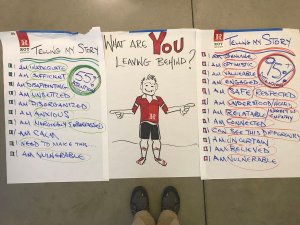
It was from this activity that I knew what we were learning was going to be absolutely applicable to my daily work. Much of my day is comprised of brief 5 minute interactions with colleagues, parents and students. And my ability to be ‘dialed-in’ for each of those conversations has a significant impact on my effectiveness as support in my school. How you conduct yourself is so important. We learned that ‘conduct’ is where everything inside of you, meets everything outside of you, and the way I conduct myself creates an ‘atmosphere’ in others.
With colleagues in the school, it’s important that the atmosphere I’m creating is one of safety… but not comfort. Particularly with all the changes happening in education, it’s more important than ever that educational leaders are encouraging movement from comfort through discomfort – but from a place of safety. High performance professionals who are heavily engaged in their work are not comfortable.
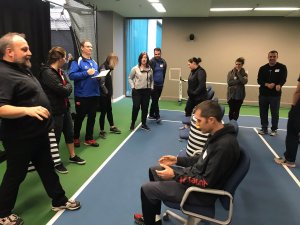 Through our second activity we started to explore what meaningful feedback looks like. We were partnered up to complete a task which involved tossing tennis balls from a seated position, and through multiple iterations discovered the relative value of encouragement versus detailed information as feedback. This is where we also began to examine coaching as a vehicle for feedback, mentorship and, ultimately, leadership.
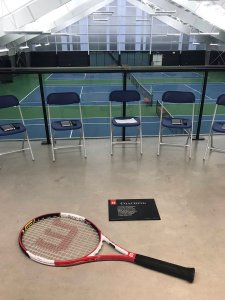 In the afternoon this understanding was further refined as we hit the tennis court to start using a coaching model for providing feedback. Chis kicked off the session with an intro to tennis pro turned philosopher Tim Gallwey. Gallwey is the author of The Inner Game of Tennis, a psychological examination of sport performance phenomenon. In it, he describes two selves: Self 1, which is analytical, ego-driven and gets in the way of Self 2, which is more unconscious, intuitive and physical. When an athlete is ‘in the zone’, they are fully realizing their Self 2 potential. The secret to the Inner Game is really to find how to get Self 1 out of the way of Self 2.
For the purposes of this activity, we participants were arranged in trios, with a coachee (player), coach, and super coach who would provide feedback to the coach on their performance. Coaches used something called The Question Funnel with their players; a series of questions designed to increase awareness and focus attention. Meanwhile, the super coaches who were observing the work of the coaches with the coachees followed The Feedback Model. This model employs three simple, but powerful questions: 1. What went well? 2. What was tricky?, and 3. What would you do differently next time? Once the coach had the opportunity to provide reflections of their own, then the supercoach was able to offer their thoughts. 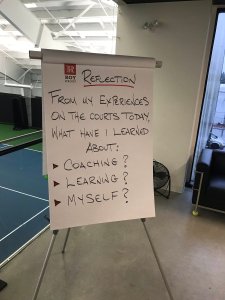 The ideas we had established earlier about quality feedback needing to be more informative than encouraging were also reinforced through this activity. We each had an opportunity to try all 3 roles, and from this activity I learned that as a coach/mentor it’s important to be highly attentive, to allow the student to define their own goals, and to remember that learning is a reflective process that works best when people feel safe.
To wrap up a very full Thursday, Chis introduced us to ‘Henderson’s Disciplines’ – 4 ideas, that when combined together provide a powerful framework for decision making. They are: Reflect, Inquire, Pause and Act. Chis reminded us that reflection cannot be superficial – it must be rigorous to be useful. And that pausing really is important, despite how difficult many of us find it to do. 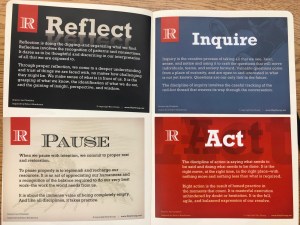 And so for homework, we were challenged to carve out an authentic and meaningful pause; to take a break from the day, and to make a conscious effort to relax at some point between when we ended our Thursday and began our Friday. Unfortunately for the Handsworth participants this also happened to be our Parent-Teacher Interview evening. But needless to say, we did our best!
On Friday we moved locations from the tennis courts to a seminar room at a local rec centre. The focus for Friday was to take the theory and concepts we had learned, and bring them to bear on a real problem of practice we were dealing with. Essentially it was to bridge the theory with the real world and to make it explicitly applicable. 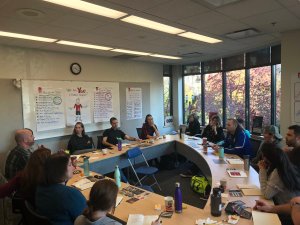
Our first activity was to form new trios of coachee, coach, and super-coach, but this time we weren’t refining tennis skills, but rather coaching our colleagues through real work issues. Ian and Chis provided us with an exemplar to start, and then we broke out in to different spaces to work. It was a wonderful opportunity to practice using these new tools we had just been equipped with, in a real world situation.
Another tool which was added to our belt to work through these issues was the GROW Model. GROW stands for Goal, Reality, Options and Will, and each category includes a series of questions to be used to drill down into a problem and help work towards a possible resolution.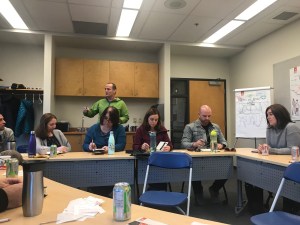
As a coachee, it was insightful to have a coach who could take my issue in unanticipated directions with their questions. It forced me to examine it from a new perspective. I also noted that I didn’t need my coach to have all the answers – the coach is not going to be the source of the solution; they are just there to facilitate my own reflection and to take it in different directions.
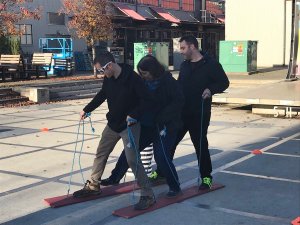 Our culminating activity for the day was an outdoor competitive group challenge. We were divided into 4 teams, each with a coach to help guide using the Question Funnel, and supercoach to employ The Feedback Model with the coach. Our team challenge was a timed obstacle course, and brought together many of the concepts we had already learned, including having the coachees (the team) determine their own goals. We were encouraged to practice our questioning techniques, rather than telling people what to do, and were reminded that leaders are able to check their emotions by grasping themselves, grasping their team, and finally grasping the task at hand.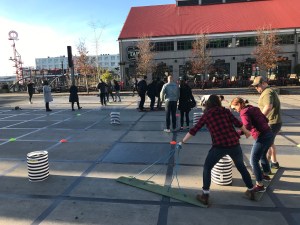
As we wound down the experience and debriefed some of our takeaways, we discussed how leaders don’t create followers, they create other leaders. And that good coaching is really having the right conversation before, and having the right conversation after.
We were challenged to identify 10 topics we hope to be coached on, and by whom, and to write them down. Lastly, we set some tangible goals for ourselves, moving forward, and committed to practicing our new coaching and leadership skills in some way. For me, I’m pleased to say I’ve already brought these lessons to bear on my own practice by using The Feedback Model in conducting performance reviews. I also feel better equipped than ever to navigate some of the complex relationships and difficult conversations I regularly encounter in my role.
This was a wonderful professional development experience, and I would highly recommend it for anyone in a position of leadership, or who works in a highly relational industry. It was great to have the chance to work with the team from Carson Graham as well. I’m looking forward to integrating these skills even more into my daily work, as I know they’ll serve me well. Thanks to Ian Chisholm, Ian Kennedy and the Handsworth and Carson Graham teams.
 Education Rumination
You must be logged in to post a comment.