Building Together: The New Handsworth School

If you’ve ever completed a renovation, or been fortunate enough to construct a home from conception to move-in, you know what an all-consuming labour of love it can be; the orientation of every space, every fixture, the allocation of square footage – all of it painstakingly considered and weighed against other aspects or features.  This has been our journey for the last 4 years, beginning on January 15th, 2018 when former Education Minister Rob Fleming announced that our well-loved, 60-year-old Handsworth School, would be replaced.

Flash-forward to February 7th, 2022, and opening day of the new school.  It’s the first day of Semester 2 of the new school year and, somehow, we’ve actually managed to have our project completed over 7 months ahead of schedule!  Instead of moving in, in September of 2022, we were able to start moving and setting up in January – a remarkable feat in of itself.

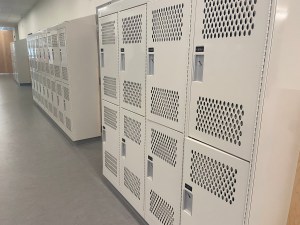
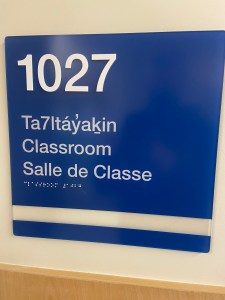
The past 4 years we’ve had to wear many hats (both literally and figuratively!) as we were able to provide significant input into how the building would be constructed.  The Handsworth Design and Input Committee allowed our faculty, staff, students and PAC to have their voices heard.  Elements like end-of-trip showers and storage for staff who commute on bikes, to staff prep areas, to purpose-built millwork, storage and technology in classrooms all had significant stakeholder input.  We were able to learn much as well from visits to recently constructed schools in the area, including Salish Secondary in Surrey, New West Secondary, and our neighbouring Argyle Secondary here in North Van, as well as post-secondary institutions like BCIT’s Burnaby and Downtown campuses.  Thoughtful details like vented, oversized athletics lockers for field-hockey sticks and football equipment, and covered outdoor instructional areas were ideas born out of our consultative process with all our stakeholder groups.  We are also so proud to be the first school in the North Vancouver School district to have the local Indigenous rights-holders with their language in the school.  Much of the signage in our school has Sḵwx̱wú7mesh language first, followed by English and French.

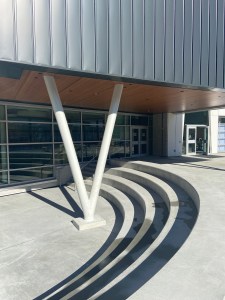
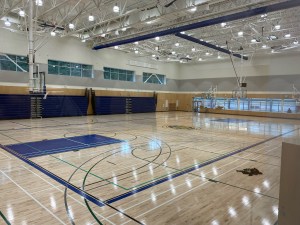
Handsworth has a proud tradition of excelling not only in academics, but in extra-curricular areas as well, including the performing arts and athletics.  Our 300-seat theatre is one of the spaces we’re most proud of, and we continue to work towards outfitting it without compromise with lighting, drapery and seats as part of our widely advertised ‘Take Your Seat’ fundraising campaign.  Our band room and dance studio are impressive and modern upgrades on what we had in our old building.  Our championship gymnasium was also enhanced to include no less than 12 basketball hoops, allowing games to happen in every conceivable direction, and the strength & conditioning room which supports our PHE classes and extra-curricular athletics, has been furnished with beautiful new fitness equipment.  

Our school community has made meaningful strides in recent years to enhance and build out an Inclusive Education department that welcomes students of diverse and exceptional abilities to Handsworth.  Throughout the process of the build, our department grew so greatly that we needed to adjust and expand, doubling the size of space allocated to its programs.  The result is a wonderfully significant investment in functional spaces for all our students that makes our school even more inclusive and supportive of all learners.

While all of this construction was happening, the day-to-day business of running the school continued unabated.  Many weeks would have some days in jeans, safety vests and hard hats, while others it was back to blazers and slacks to take care of the traditional administration of the existing school.  There were times it really felt like I had 2 distinctly different jobs!  And while I’m certainly not a designer or architect, I got to feel like one along the way as we selected furnishings and re-imagined some of the spaces.

As a school community, we also had to manage, and continue to manage, the absence of a school field or really any outdoor facility for both our PHE classes and athletics teams.  Although phase 1 is now finished, we continue to work and learn next to a construction site that is actively decommissioning and demolishing the old school.  Our hope in this next phase is to also augment all the great work done in the building with equally impressive exterior amenities like EV charging stations for vehicles, and to work with our community to advocate with the District of North Vancouver to support our aspirations for a turf field for the benefit of our PHE classes and athletics that are both school and community-based. 

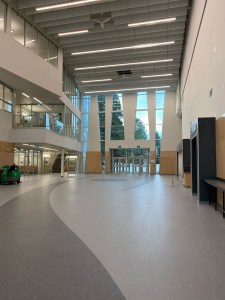
Like a renovation or building a house, having new is nice.  But what makes a house a home is the people.  At the heart of everything we’ve done is a focus on making visible everything great that our students and staff do every day, and to forge an even greater sense of identity, built on strong traditions that honour the past but are also looking forward.  Light, glass, and collaborative spaces all speak to how we hope students will thrive, collaborate and grow in their new surroundings. 

I would be remiss if I didn’t also acknowledge many of the adult people behind the scenes as well who have helped this project along.  We’ve been so fortunate to have a Project Superintendent, Russ, who also happens to be a 2006 Handsworth alumnus.  Throughout the project it was really apparent the personal pride he took in the construction.  He was incredibly generous with the access he provided us to the site, which was completely above and beyond what typically would have been granted to a project of this size and scope.  Our wider Handsworth community rallied around in support as well, from parent involvement in our theatre seat fundraiser, to Len Horvath whose time and expertise has been integral to bringing industry-leading lightening technology to our theatre, to Carol Anne Parkhill who quietly assisted in the background with some of the amazing furniture in the building.  Other people who were indispensable along the way were Project Manager Mark Thomson, our Purchasing Officer Annmarie Sharman who helped us procure all our furnishings, and of course our Principal, Rupi Samra-Gynane, who came with a clear vision on how to make this house a home.  It’s been such a positive team of professionals to work with.

We hope this new space will offer some fresh inspiration for our students – an opportunity to be excited again about re-connecting and finding a sense of place and belonging, especially as we emerge from the Covid pandemic.  We’re able to feel now that our building is a proud reflection of the quality of our school community.  And if you haven’t had the opportunity yet, we’re certainly looking forward to welcoming you to our new home!
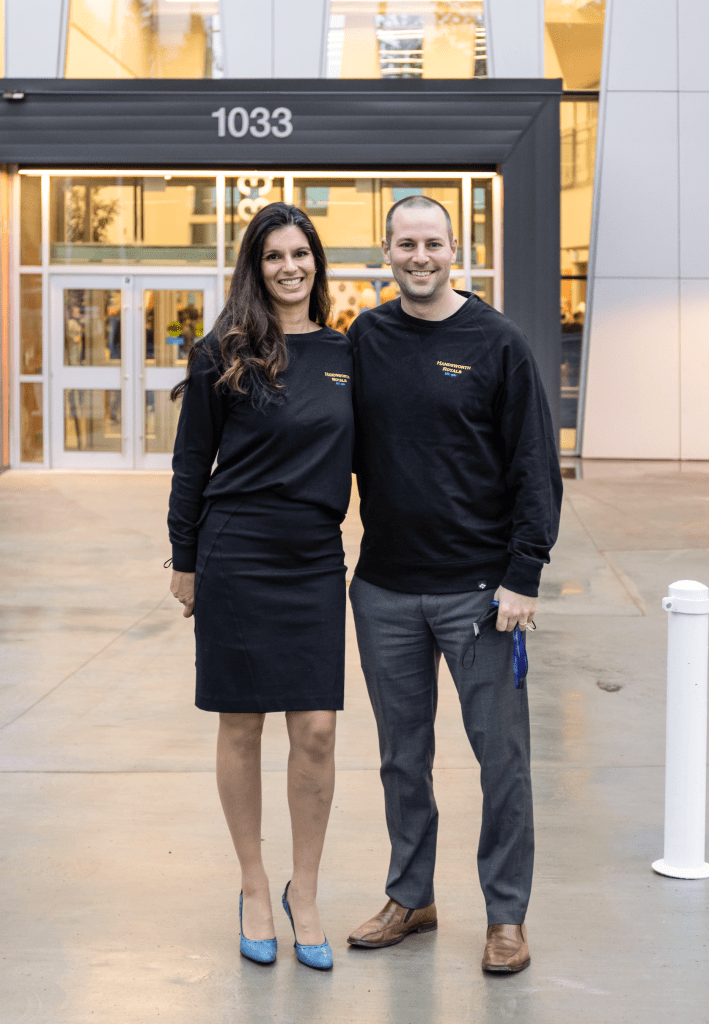

Rupi and I on opening day
Building Together: The New Handsworth School

In Praise of Team Teaching

Teaching is a social art. The interaction between teachers and students, and students with students is a process we as educators are always trying to find ways to refine. We’ve all heard about the push away from ‘the sage on the stage’ to ‘the guide on the side’, but hopefully it will come as no surprise to people that teaching, does, in fact, at some point require being in front of your students imparting some pearls of wisdom. There’s a reason the traditional lecture is still used in many post-secondary classes. It is still one of the most efficient ways to pack a lot of information into a lesson. But if we’re being honest, listening to one person deliver a monologue on any topic has its limits. If you’ve watched one of the many popular TED talks videos, or been to a TED event yourself you know that the majority of these engaging talks are less than 20 minutes in length. Listening to one voice for any longer can easily become tedious. And here, I would suggest, we find the first reason that team teaching is a technique that should be employed more often.

Two teachers collaborating to tackle a single topic can provide a much more interesting dynamic than any single teacher could. The difference in intonation, inflection and cadence of each speaker can reinvigorate a lesson. Moreover, with each teacher giving their unique perspective on the topic, greater insight and expertise is provided. Some speakers are better at giving concise explanations, while another may teach using anecdotes and stories. In a team teaching setting there’s room for both.

When delivering a lesson solo it can be easy for your plan to be side-tracked, or for you to lose focus on the intended outcomes. Having a second teacher to help guide things back on course can be a huge benefit.   In my experience, class discussions led by two teachers tend to be richer, as having a second ‘expert’ opinion and a second set of rich life experiences can help inform the conversation. Two teachers are able to debate opposing sides of an issue, build upon each others points and can even correct or clarify each others facts thereby ensuring students have an accurate understanding. Clearly a high level of trust and excellent rapport needs to exist between team teachers if they are going to be successful.

A team teaching scenario can provide the potential to pair a novice teacher with a more veteran teacher. Teaching is a profession that benefits immensely from having mentorship relationships. Too often new teachers are thrust unprepared into their first year classroom and are only able to seek out fleeting guidance during lunchtime or afterschool if any colleagues are available.   The mentorship possibilities alone have the potential to raise the quality of teaching for all students.

Another pedagogical advantage is the potential for small group activities. This is made possible by the decrease in the student to teacher ratio. In cases where team-teaching involves even more than two teachers, jigsaw activities and intense small group discussions with increased student engagement and accountability are possibilities. Cross-curricular possibilities abound, with team-teacher pairs emphasizing the connections during a lesson between each of their curricular expertise areas.

Simon and I team teaching in Central Park, New York

My best lessons are the ones I have done in a team-teaching environment. During summer I teach with MEI Academy, a study-abroad program that provides lessons on location around the world. The vast majority of the lessons I deliver during that time are done with a teaching partner. For the last 3 years I’ve been teaching with a remarkable educator and friend named Simon. In preparing together for lessons we’re able to identify which instructional elements each of us should be emphasizing. For example, in a business lesson on game theory I will make sure I’m prepared to discuss Nash Equilibrium and the prisoner’s dilemma, while Simon will make sure he has polished up the accompanying interactive activity which will sharpen the students understanding. In a lesson on debate perhaps I will focus on pathos, while Simon focuses on discussing logos or ethos. Each of us is responsible for making sure a particular element of the lesson is refined, while both being permitted to also contribute to the piece the other is preparing. By focusing on preparing only a portion of the lesson, the prep time required is actually decreased while the quality of instruction is simultaneously enhanced. And with practice and over time the lessons become seamless with each of us contributing our equal part.  In a time when we are, more than ever, asking our students to integrate, synthesize and think critically, having two teachers who are able model the integration of each other’s ideas in front of the class serves as a powerful example.

Simon and I team teaching at the Pantheon in Paris

Simon is a far more entertaining speaker than I am, so I’m thankful when he’s able to interject with an amusing anecdote or story that supports the learning objectives I’m trying to achieve with the students. Having two teachers with different personalities also means we are connecting with the students in two distinctly unique ways. The importance of the teacher-student relationship has been increasingly emphasized as vital for student achievement. This end is clearly supported by having two teachers who are able to cultivate those relationships in different ways.

So why is team-teaching not more widely used? Firstly, it is not economical. For arguments sake let’s say the average classroom holds 30 students. To have two teachers instruct 30 students costs double the price a solo teacher would. “So why not double the space?” you ask. I remember there was a time when this used to be done. At Handsworth we used to have something called ‘large group’, where 60 students would pile into a double sized classroom and 2 teachers would deliver a lesson together. It was great. Students who were all going to be tested on the same content could be sure they weren’t missing something the other students were getting in another teachers class because they were all learning it in the same place at the same time. The novice teachers could see how the senior teachers taught the subject and everyone would be on the same page in terms of the assessment and expectations of the students. But, alas, it happens no more. The complexities of scheduling simultaneous blocks of the same class were such that students ended up taking the class at differing times, and so synchronizing a ‘large group’ appeared to become impossible. And with time it seems that scenario has become a lost discussion. Finally, the large group room that was once used has since been converted into two separate classrooms – a consequence of a school at capacity looking for more instructional space. I suspect the need for smaller separate spaces is similar in other schools that also follow the traditional classroom model.

Many teachers themselves are reluctant to try team-teaching. It falls outside the comfort zone of many who have long held routines and teach their subject the way they’ve always taught it. It takes a teacher who is willing to be vulnerable and not worried about being judged to have a colleague in their classroom while they teach. As professionals, some of us still have this fear that we might be inadequate at what we’re doing, or perhaps ‘behind the times’. And opening the door to another teacher is to expose all our instructional warts. My experience, however, has been that I work with remarkable teachers. And we have far more to learn from each other’s classrooms than we have to worry about. Team-teaching celebrates the great things each teacher has to bring to the table, and doesn’t place a value judgement on what’s not working – because to teach with a partner is to demonstrate a willingness to improve. I hope to have the opportunity to team-teach more in the future as I believe collaborating with colleagues raises the quality of the educational experience for students.

In Praise of Team Teaching